AI in Security Operations: 6 Challenges Security Leaders Need to Solve
AI in Security Operations: 6 Challenges Security Leaders Need to Solve
Security leaders bringing AI into security operations have six critical challenges to address: trust, human oversight, access and permissions, workflow integration, performance measurement, and production readiness. How organizations address these questions will determine how much responsibility AI can safely take on in the SOC.
AI is already being used or evaluated to triage alerts, investigate suspicious activity, prioritize threats, and support response. Agentic AI takes that further by giving systems the ability to interact with tools, access data, make decisions, and potentially take action.
For security leaders, adoption and risk management are increasingly happening in parallel. According to Proofpoint's 2026 Voice of the CISO report, 85% of CISOs say enabling the safe use of AI is a top priority over the next two years. At the same time, 78% view generative AI as a security risk, and 79% expect to manage AI-related risks without a proportional increase in resources or expertise.
The challenge is determining whether an AI system can perform its role effectively, operate within appropriate boundaries, work alongside people and existing tools, and ultimately improve security outcomes.
Key Takeaways
AI agents need to demonstrate consistent performance under realistic security conditions before organizations expand their responsibilities.
Human oversight should be based on the risk and potential impact of an AI agent's actions, rather than applied uniformly to every task.
Access, authority, and autonomy can increase AI agent risk, making clear permissions and operating boundaries critical.
AI performance should be measured by its impact on security outcomes and analyst workload, not speed or task completion alone.
AI readiness can change as agents, workflows, permissions, and threats evolve, making ongoing validation important.
1. How do you know when to trust an AI agent's decision?
AI agents can process security data quickly, but trust requires evidence that they reach accurate conclusions consistently, recognize uncertainty, and respond appropriately to incomplete, conflicting, or unfamiliar information.
The stakes are particularly high in security operations. An incorrect conclusion about whether activity is malicious, whether an account has been compromised, or whether an incident warrants containment can have operational consequences.
AI systems can also produce inconsistent or inaccurate outputs even when they perform well on standardized evaluations. The International AI Safety Report 2026 describes AI capabilities as "jagged," with performance varying considerably across tasks and contexts. The report also notes that strong benchmark performance does not necessarily predict real-world AI performance.
Microsoft similarly cautions that AI used in security operations can produce inaccurate or incomplete results and emphasizes the importance of human judgment and verification before acting on critical outputs.
For security teams, trust therefore cannot be based solely on whether an agent successfully completes a task. It also requires understanding its limitations and how much responsibility its demonstrated performance warrants.
2. When should an AI agent act independently, and when should a human step in?
The appropriate level of AI autonomy depends on the risk of the action, the agent's demonstrated performance, and the organization's ability to detect and recover from mistakes. Higher-impact actions warrant stronger controls, clear escalation criteria, and meaningful human oversight.
That means "human in the loop" isn't enough as a general policy. A risk-based approach defines where human approval is required, when an agent should escalate, which actions can be taken independently, and what happens when the agent encounters a situation outside its expected operating conditions.
Current Gartner research similarly emphasizes that AI agent governance needs to reflect the risk of the specific use case. It recommends embedding enterprise rules, data boundaries, approvals, and escalation paths into agent controls rather than relying on the model or task prompt alone.
As AI agents take on more SOC responsibilities, defining that division of responsibility becomes increasingly important. What CISOs Can Expect from the Agentic SOC explores how AI agents may change security operations and the role of human analysts.
Effective oversight defines where humans and AI each belong based on the risk and responsibility involved.
3. What should an AI agent be allowed to access and do?
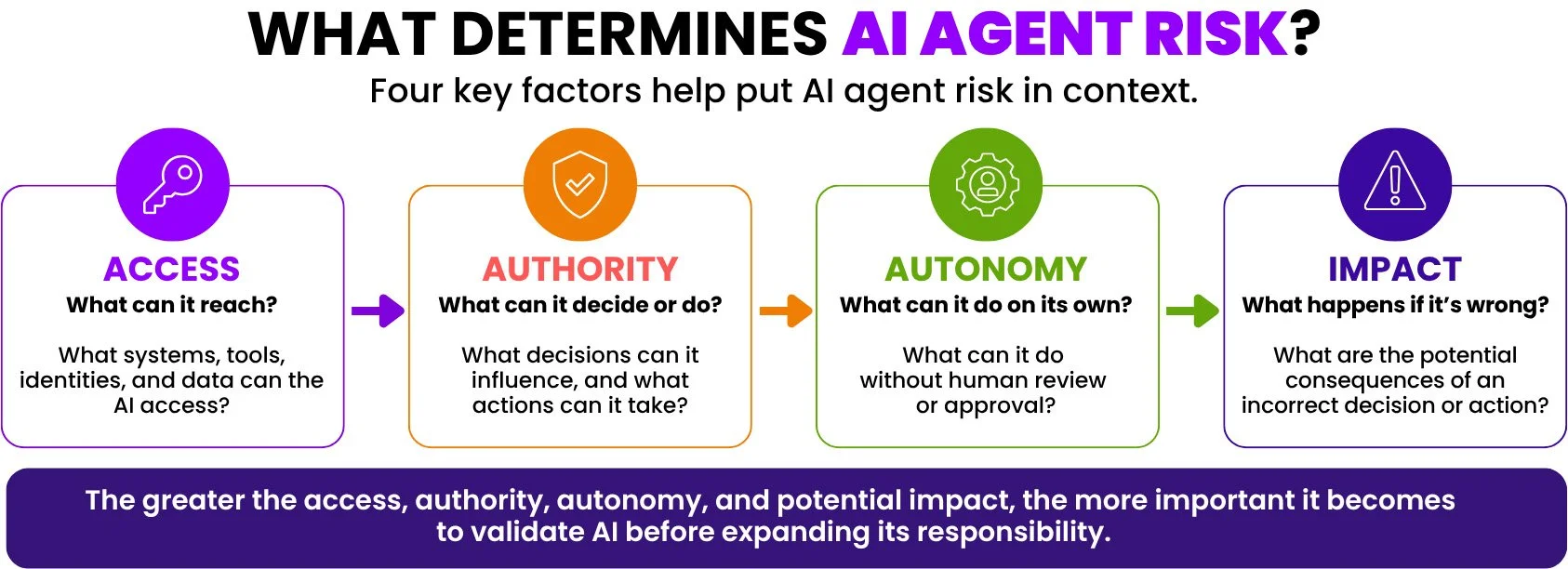
An AI agent should have only the data access, permissions, tools, and authority required for its intended role. As an agent gains access to sensitive data or the ability to take higher-impact actions, the controls governing what it can access, attempt, and do become increasingly important.
Best practices include evaluating what information an agent can retrieve, which tools it can invoke, which actions it is authorized to take, and whether those privileges remain appropriate as its role changes. That evaluation can also account for threats such as prompt injection, which can manipulate an agent's behavior or potentially cause it to misuse the tools and permissions it has been given.
This is one reason AI agent security extends beyond checking an agent's output for an obviously incorrect or unsafe response. Visibility into what the agent accesses, attempts, and does becomes equally important. As explored in How Agentic AI Expands the SOC Attack Surface, greater tool access and delegated authority can introduce additional security considerations as agents become more deeply integrated into SOC workflows.
The OWASP Top 10 for Agentic Applications for 2026 highlights risks including agent goal hijacking, tool misuse, and identity and privilege abuse. These risks show why controls must govern what an AI agent is designed to do and the tools, data, permissions, and authority available to it.
For security operations, that means the question isn't just, "Did the AI give the right answer?" It is also, "What happened because of that answer?"
4. How do you integrate AI into existing security operations?
Integrating AI into security operations requires more than connecting it to security tools. AI agents need access to the right data and telemetry, clearly defined roles within operational workflows, and the ability to work effectively with the tools, processes, and people already involved in detection and response.
Security operations environments are rarely clean or uniform. Analysts work across multiple tools and data sources, investigate incomplete information, encounter conflicting signals, and follow workflows that reflect the organization's own technologies, policies, and risk tolerance.
An AI system tested primarily against clean or standardized inputs may behave differently when introduced into that environment.
Gartner's research on AI SOC agents specifically identifies access to high-quality data and workflows as important to using agents to improve detection, prioritization, and response.
Integration therefore involves more than connecting an API or adding another tool to the security stack. Forward-looking security teams are evaluating how AI fits into existing workflows, what information it depends on, how it interacts with security controls, and where its involvement actually makes analysts and the broader operation more effective.
5. How do you measure whether AI is actually improving security operations?
Measuring AI performance in security operations requires looking at both AI performance and security outcomes. Useful signals include:
Whether decisions are accurate and appropriate across different security situations
How often the agent produces false positives or false negatives
Whether the agent escalates appropriately when human judgment is required
How AI affects detection, investigation, and response performance
Whether performance remains consistent as conditions and inputs change
Whether AI reduces analyst workload without introducing new failures or operational risk
An AI agent can process more alerts, summarize investigations faster, or complete tasks in less time without necessarily making the security operation more effective.
The broader question is whether AI performance translates into better security outcomes. Does detection improve? Are investigations more accurate? Does the agent escalate appropriately? Does it reduce analyst workload without introducing new failures?
A meaningful baseline also provides important context. How does the agent perform compared with the security team's current process? How does it perform compared with a human analyst facing the same attack? And perhaps most importantly, does the combination of humans and AI produce a better result?
Those comparisons can help security leaders move beyond asking whether an AI agent works to asking whether it measurably improves security operations.
6. How do you know whether an AI agent is ready for production?
Evidence that an AI agent is ready for production should show how well it performs under realistic operating conditions, whether it stays within defined boundaries, how it handles uncertainty and unfamiliar situations, and when it escalates to human judgment.
The International AI Safety Report 2026 describes an "evaluation gap" between pre-deployment testing and real-world performance. It concludes that performance on pre-deployment tests does not reliably predict real-world utility or risk, and notes that evaluations designed specifically for AI agents face similar limitations.
That gap matters in security operations, where an agent may encounter noisy telemetry, contradictory evidence, unfamiliar attacks, adversarial inputs, unexpected system behavior, and situations its developers did not anticipate. Recent incidents involving AI agents also illustrate why organizations need to understand unexpected behavior before giving agents greater responsibility. AI Agent Testing: What Recent OpenAI, Anthropic, and Meta Incidents Mean for Enterprises looks more closely at that issue.
Production readiness therefore requires more than confirming that an agent can perform its intended task. It also considers how the agent behaves under pressure, where it fails, whether it stays within defined boundaries, when it asks for help, and whether its performance holds up as conditions change. A structured AI agent validation process can help establish that evidence before the agent is given authority in production.
AI validation also cannot end at deployment. Models and agents evolve, security tools and workflows change, and threats continue to develop. NIST has highlighted the importance of monitoring AI systems over time because they can exhibit variability and unpredictable behavior after deployment.
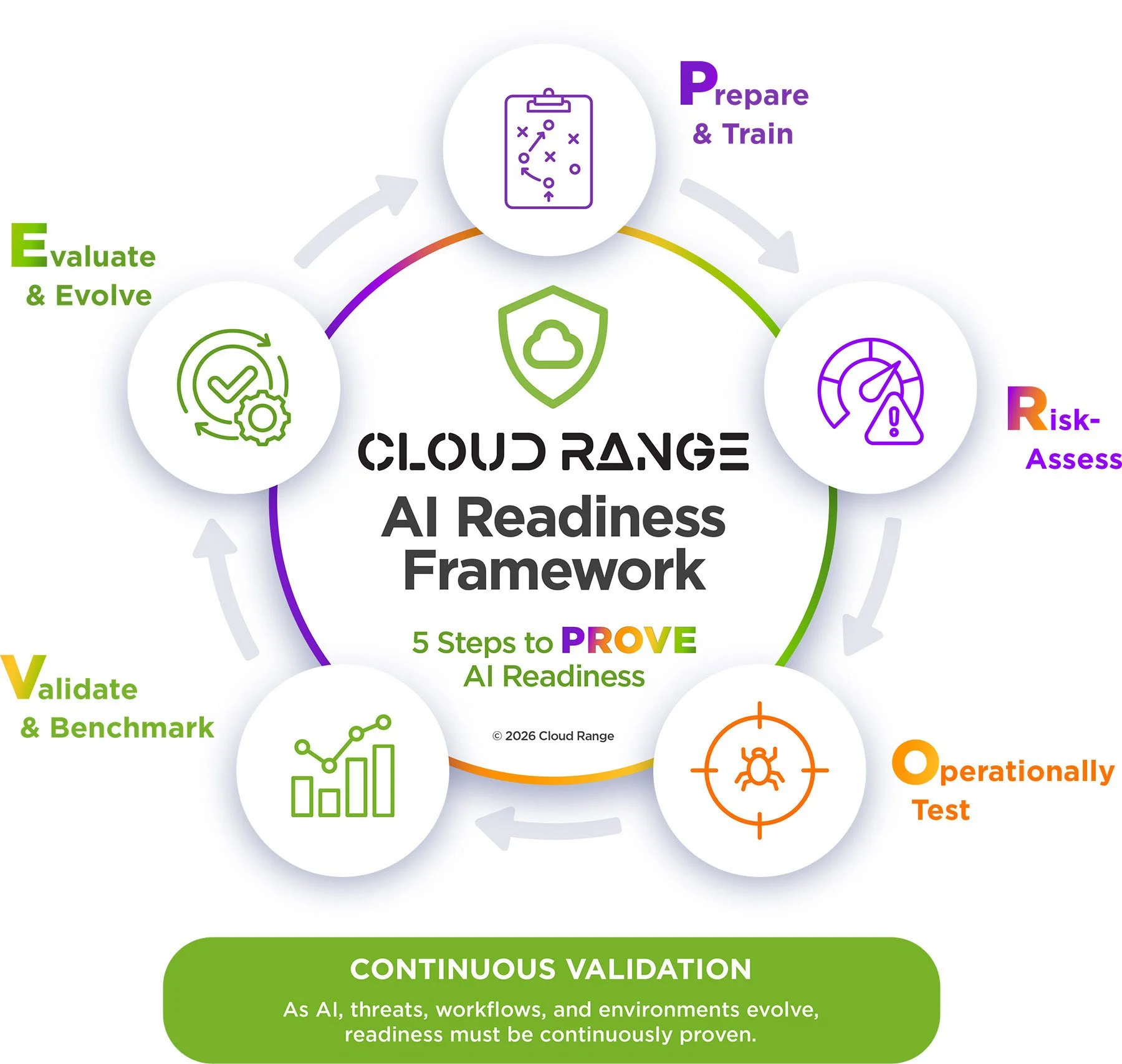
AI readiness is not a one-time determination. It requires ongoing evidence.
Moving From AI Adoption to AI Readiness
Across all six challenges, one theme is consistent: confidence in AI readiness comes from evidence of how AI behaves in the environment where it will actually operate.
That shifts the focus from assumptions about what an AI model or agent can do to evidence of what it actually does: how it responds to attacks, what it accesses, how it makes decisions, where it fails, when it escalates, and how its performance compares with the people and processes already responsible for defending the organization.
Operational validation provides that evidence.
Cloud Range's AI Validation Range™ gives organizations a realistic, non-production enterprise environment where they can test AI models and agents against cyberattacks, evaluate behavior and performance, train agentic AI, and benchmark AI against human defenders under the same conditions. Ongoing validation allows organizations to reassess readiness as models, agents, threats, and security operations evolve.
Adopting AI is only the beginning. The harder question is whether an organization can prove that its AI is ready for the responsibility it is being given.
Learn more: The Cyber Readiness Guide for Agentic AI provides a practical framework for training, testing, validating, and benchmarking AI throughout its lifecycle.
Frequently Asked Questions
What is an AI SOC agent?
An AI SOC agent is an AI system designed to perform or assist with security operations tasks, such as alert triage, investigation, threat detection, enrichment, prioritization, or response. Unlike simpler AI assistants, agentic systems may interact with tools, data, and other systems and can potentially take actions with varying levels of autonomy.
What are the biggest risks of using AI agents in security operations?
Key risks include incorrect or inconsistent decisions, excessive access or permissions, exposure of sensitive data, manipulation through adversarial inputs, inappropriate autonomous actions, poor escalation behavior, and overreliance on AI outputs. The level of risk depends heavily on what the agent can access and what authority it has.
How should organizations test AI agents before deployment?
Organizations can evaluate AI agents against realistic security conditions that reflect the data, tools, attacks, workflows, and situations they may encounter after deployment. Testing should examine not only whether the agent completes its assigned task, but also how it handles uncertainty, unfamiliar situations, adversarial inputs, escalation, permissions, and failure.
What is the difference between AI testing and AI validation?
AI testing examines whether a model or agent performs as expected under defined conditions. AI validation goes further by gathering evidence that the system is ready for its intended role,