Are Cybersecurity Teams Ready for AI Incident Response?
Are Cybersecurity Teams Ready for AI Incident Response?
Most cybersecurity teams have limited practical experience responding to AI-related incidents. ISACA's State of Cybersecurity 2026 found that only 8% of organizations regularly conduct AI-specific incident response exercises. At the same time, AI is becoming embedded in the security operations those teams depend on.
The result is a growing readiness challenge. Security teams may be increasingly familiar with using AI, but responding when an AI system is compromised, behaves unexpectedly, exposes sensitive information, or takes unauthorized action requires a different kind of experience.
Key Takeaways
AI adoption is moving faster than AI incident response readiness. While 41% of cybersecurity teams use AI to automate threat detection and response, only 8% of organizations regularly conduct AI-specific response exercises.
AI incidents can cross traditional security boundaries, requiring responders to trace model interactions, identities, data access, API calls, tools, and downstream actions.
An AI incident response runbook documents the intended response; realistic testing reveals whether teams can actually execute it.
AI incident response depends on human judgment as well as technical expertise, particularly when evidence is incomplete or AI-generated recommendations cannot be trusted.
Repeated technical and live-fire simulations can help teams build practical readiness before an AI-related incident occurs in production.
Why Is AI Adoption Outpacing Incident Response Readiness?
Security teams are adopting AI faster than they are building practical experience responding when AI creates, amplifies, or becomes part of a security incident.
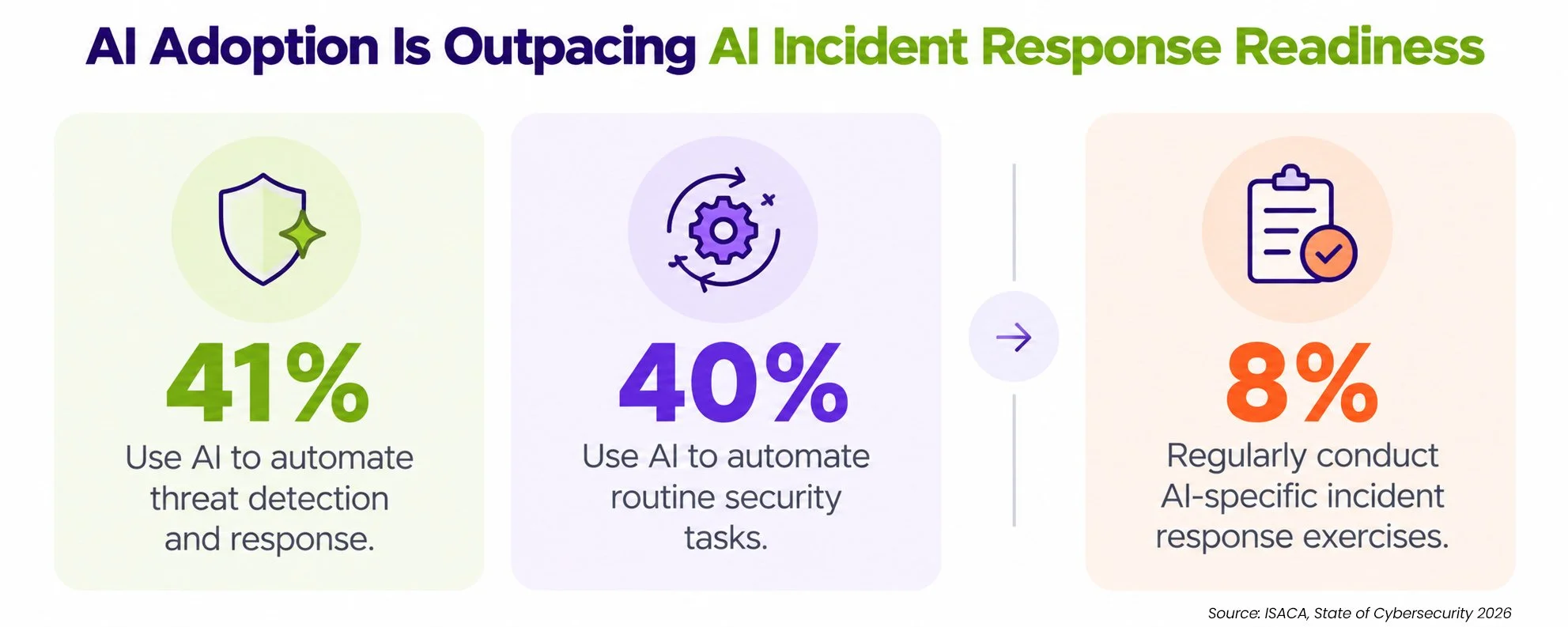
ISACA’s research found that 41% of cybersecurity teams now use AI to automate threat detection and response, up from 32% in 2025, while 40% use it to automate routine security tasks.
Cybersecurity professionals are also increasingly responsible for AI beyond the SOC: 51% are involved in developing, onboarding, or implementing AI solutions within their organizations.
That expanding role creates a new kind of operational dependency. AI may now help prioritize alerts, correlate events, summarize investigations, recommend remediation, or even initiate response actions. Security professionals are simultaneously being asked to assess and secure AI systems deployed elsewhere in the business.
Yet 45% of respondents identify LLM SecOps as a cybersecurity skills gap, up from 24% just two years ago. The people responsible for securing AI are gaining that responsibility faster than the profession is building practical expertise around it.
The lack of practiced responses means some analysts may encounter AI-related failure modes for the first time during an actual incident. A team might understand conventional credential theft or data exfiltration well, for example, yet have little practical experience investigating prompt injection, tracing sensitive information exposed through an LLM, determining what actions an autonomous agent performed with a compromised identity, or deciding whether an AI-generated recommendation can be trusted during containment.
AI also changes the defender's own decision-making environment during an incident. If analysts increasingly depend on AI to interpret telemetry or recommend response actions, an AI-related incident can force them to question the same tools they normally rely on to investigate it.
Analysts need enough experience to recognize unreliable output, challenge automated recommendations, reconstruct what an AI system actually did, and take manual control when automation can no longer be trusted.
Using AI every day creates familiarity with the technology. It does not automatically create incident response competence around it.
Why Do Security Teams Need to Practice AI Incident Response?
AI incidents introduce unfamiliar technical failure modes and can make it harder for responders to determine what happened, what was affected, and how to contain it.
Teams that have never worked through those problems under realistic conditions may find that conventional incident response assumptions do not map neatly onto the incident in front of them.
Consider prompt injection against an AI agent with access to internal systems. Confirming that the malicious instruction succeeded is only the beginning. Responders may need to establish:
What data did the agent access or retrieve? This could extend well beyond the information ultimately returned to the attacker.
Which tools did it invoke? An agent might have permission to query databases, access SaaS applications, execute code, or call external APIs.
What actions did it take? Did it send an email, modify a file, create an account, change a configuration, or initiate another workflow?
Which identity and permissions enabled those actions? The agent may operate through service accounts, delegated user permissions, API credentials, or several identities across a workflow.
Where is the evidence? Reconstructing the incident could require correlating model interactions with application, identity, API, cloud, and network logs.
This creates an investigation that crosses boundaries traditional incident response teams may be accustomed to treating separately. Responders might have to reconstruct what an AI system interpreted, what it decided to do, which systems allowed it to do so, and what consequences followed.
Why Isn't an AI Incident Response Runbook Enough?
An incident response runbook documents how an organization intends to respond, while realistic testing reveals whether its people can actually execute that response when an incident is ambiguous, incomplete, and evolving.
That distinction is especially important for AI incidents, where established procedures may encounter technologies, ownership boundaries, and failure modes that teams have little practical experience handling.
ISACA found that 48% of respondents either said their organization lacked an AI-specific incident response playbook or did not know whether one existed. Creating one would clearly improve that position, but documentation addresses only part of the readiness problem.
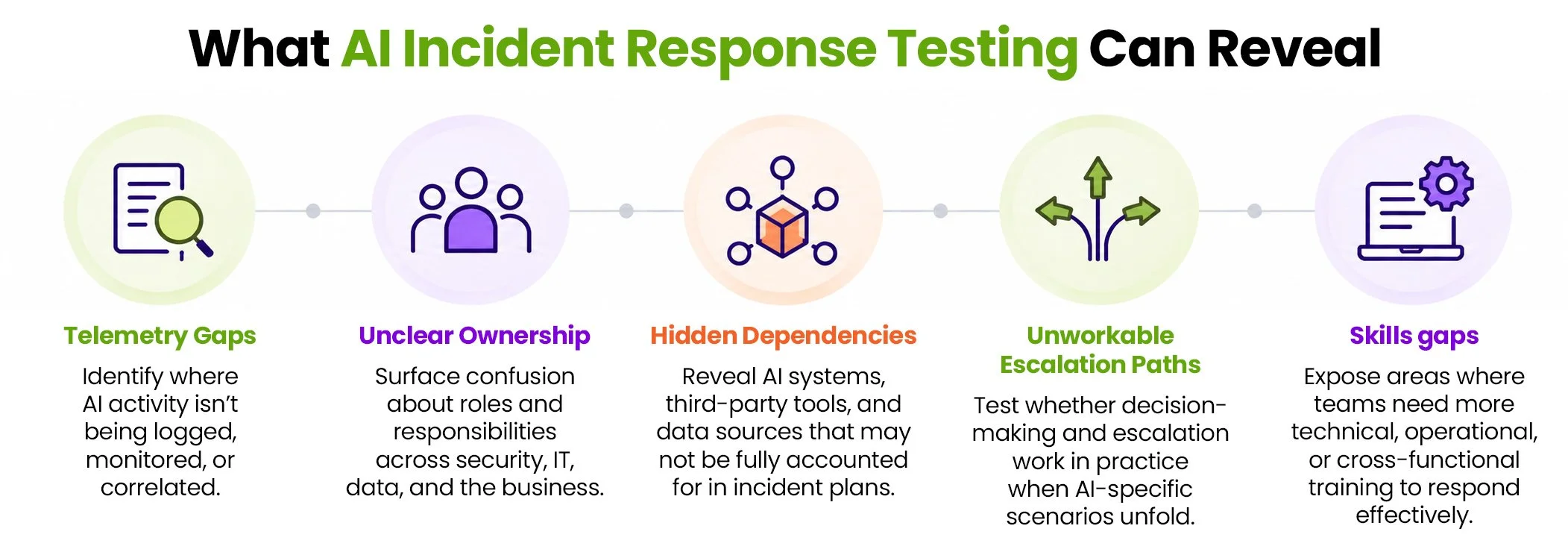
Runbooks encode assumptions. Testing those assumptions can reveal:
Telemetry gaps: The runbook requires responders to investigate an agent's actions, but API calls or model interactions aren't logged at sufficient detail.
Unclear ownership: Security identifies malicious behavior, but it isn't clear whether the SOC, AI engineering team, application owner, or cloud team has authority to disable the affected system.
Hidden dependencies: Responders plan to revoke an agent's credentials only to discover that the same service account supports other production workflows.
Unworkable escalation paths: A procedure requires approval from legal, privacy, or senior leadership, but nobody has established how to reach the right decision-maker quickly.
Skills gaps: The necessary evidence exists, but analysts lack experience interpreting model, agent, identity, and application telemetry together.
What Skills Do Cybersecurity Teams Need for AI Incident Response?
AI incident response requires technical AI knowledge alongside the investigative judgment, critical thinking, and communication skills already fundamental to effective incident response.
ISACA’s findings reinforce both sides of that equation: 45% of respondents identified LLM SecOps as a skills gap, while 57% reported gaps in soft skills such as communication, critical thinking, and problem-solving.
The challenge extends beyond that study. PwC's 2026 Global Digital Trust Insights found that knowledge and skills gaps were the top two challenges organizations identified when implementing AI for cyber defense.
Technical understanding matters because responders need to investigate systems that behave differently from conventional applications. They may need to understand how an LLM application retrieves data, which tools an agent can invoke, how prompts and model outputs are logged, which identities authorize downstream actions, and where sensitive information can move through an AI workflow.
Expertise in identity, cloud, application security, and incident response does not become obsolete. AI increasingly connects those disciplines inside the same incident.
Human judgment matters just as much. AI systems can behave probabilistically, incidents may cross multiple teams and platforms, and responders may initially have incomplete evidence about whether suspicious behavior was malicious, erroneous, or expected.
Analysts have to form hypotheses, challenge AI-generated conclusions, distinguish evidence from assumptions, and decide what additional information would reduce uncertainty. Those are fundamentally human reasoning skills.
How Can Organizations Build Human Readiness for AI Incidents?
Organizations can build human readiness by giving security teams repeated opportunities to investigate and respond to realistic AI incidents before they encounter them in production.
That means moving beyond awareness training and written procedures toward simulations that let security analysts interpret evidence, make decisions, coordinate with other teams, and contain an evolving incident.
Different approaches can test different aspects of readiness:
Tabletop exercises can test responsibilities, escalation paths, cross-functional coordination, and difficult business decisions.
Technical simulations can put responders in front of realistic telemetry and require them to investigate what actually happened.
Live-fire simulations can introduce an active adversary and test whether teams can detect, investigate, coordinate, and contain an AI-related attack while it unfolds.
The need to prepare for these situations is reinforced by NIST's Generative AI Profile, which identifies risks that are unique to or intensified by generative AI. Those risks span areas including data privacy, information security, confabulation, human-AI configuration, and value-chain integration.
Cyber ranges are particularly useful at the technical end of this progression because they let teams experience the consequences of their decisions without putting production systems at risk.
Cloud Range provides realistic environments where security teams can investigate and respond to live-fire attacks while building the technical skills, decision-making, communication, and team coordination required during an actual incident. With AI Validation Range, organizations can also test and validate AI models and agents under realistic security conditions, helping prove the readiness of both human defenders and the AI systems increasingly working alongside them.
Frequently Asked Questions
What is AI incident response?
AI incident response is the process of detecting, investigating, containing, and recovering from security incidents involving AI systems or AI-enabled attacks. It can require responders to investigate AI behavior alongside identities, applications, cloud infrastructure, APIs, data flows, and other systems involved in an incident.
What is an AI incident response exercise?
An AI incident response exercise simulates a security incident involving an AI system or AI-enabled attack and requires a cybersecurity team to work through its response.
Why do organizations need AI-specific incident response exercises?
AI systems introduce additional data flows, identities, integrations, and autonomous actions that can complicate conventional incident response. AI-specific exercises help teams understand how these technologies affect detection, investigation, containment, escalation, and recovery before they encounter those challenges during a real incident.
What skills are needed for AI incident response?
AI incident response can require expertise across incident response, identity, cloud and application security, and AI systems, as well as the ability to interpret model and agent telemetry. Critical thinking, communication, problem-solving, and cross-team coordination remain important when evidence is incomplete or AI behavior is difficult to interpret.
How can cyber ranges improve AI incident response readiness?
Cyber ranges give security teams a controlled environment to investigate and respond to realistic AI-related incidents without putting production systems at risk. Teams can practice interpreting telemetry, making decisions, coordinating a response, and containing attacks under realistic conditions.