
Assessing OT cyber readiness means determining whether your people, processes, and technology can detect threats, coordinate decisions, respond safely, and restore critical operations when a cyberattack affects operational technology (OT). The stakes are physical: production, essential services, and in some environments, human safety.
For organizations operating industrial control systems (ICS) and other cyber-physical systems (CPS), preparedness goes beyond traditional cybersecurity controls and incident response plans. It also requires understanding operational dependencies, physical consequences, and how IT, security, OT, and engineering teams work together.
Key Takeaways
OT incident response preparedness must account for physical safety, operational continuity, and dependencies between IT and OT systems.
Ransomware, supply-chain compromise, attacks involving industrial control systems, and emerging AI-related threats make coordinated preparedness increasingly important.
Seven critical areas provide a practical framework for evaluating OT cyber readiness, from asset visibility through detection, response, recovery, and validation.
Realistic OT/ICS cyber range environments, adversary emulations, and hardware-in-the-loop capabilities help organizations validate preparedness without putting production systems at risk.
Measuring team performance under realistic attack conditions provides evidence of readiness and opportunities for continuous improvement.
Why Is OT Incident Response Preparedness Different From IT Incident Response?
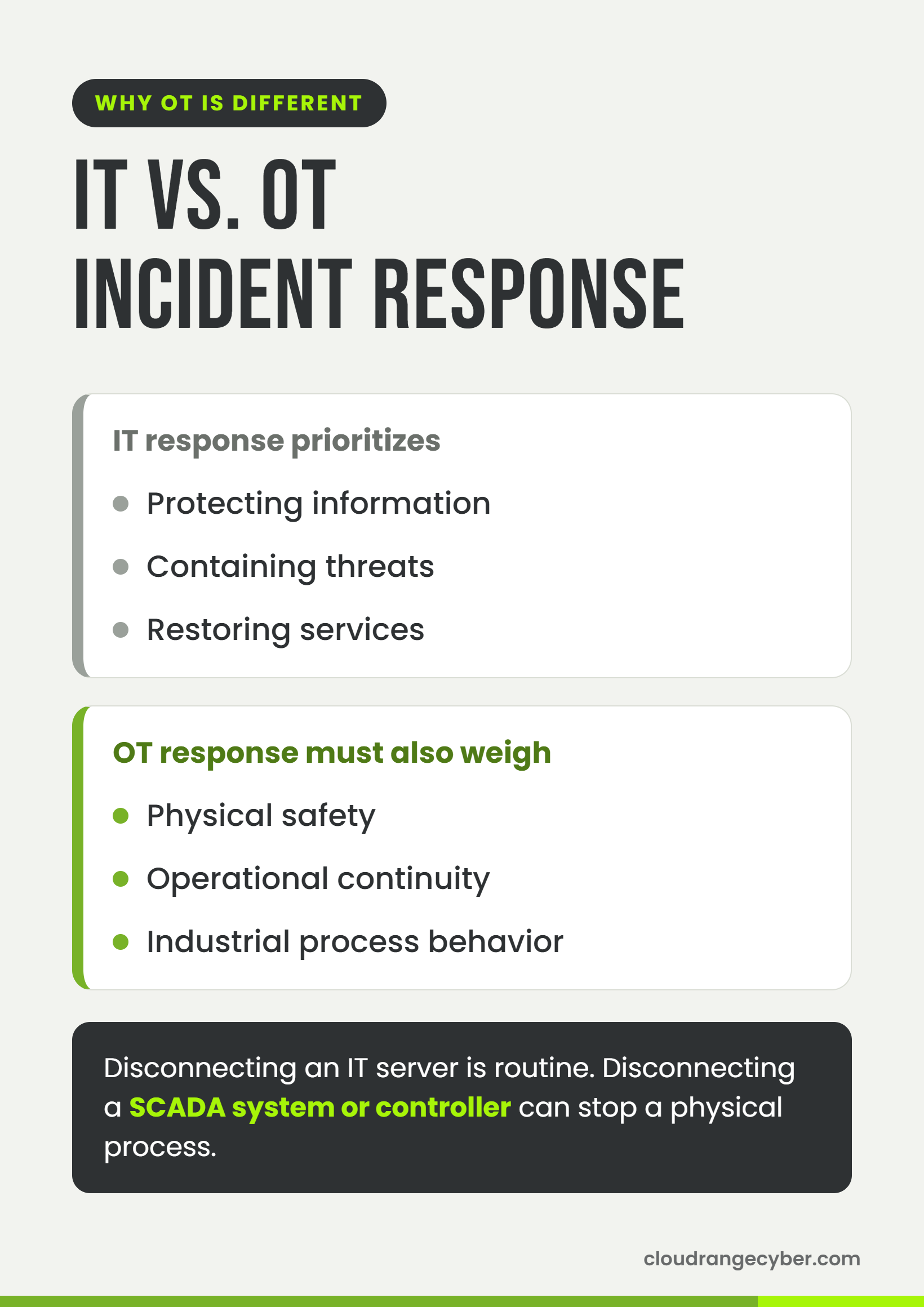
OT incident response preparedness differs from traditional IT incident response because cybersecurity decisions must account for physical safety, operational continuity, and the behavior of industrial systems. While IT incident response typically prioritizes protecting information, containing threats, and restoring services, OT response must also consider how those actions could affect equipment, physical processes, and essential operations.
A response action that is appropriate for an IT server, such as disconnecting it from the network, may have very different implications for a supervisory control and data acquisition (SCADA) system, engineering workstation, or industrial controller.
OT includes industrial control systems, building automation, transportation systems, and other technologies that monitor or control physical processes. ICS environments may include programmable logic controllers (PLCs), distributed control systems (DCS), and SCADA technologies. Cyber-physical systems integrate computation and communication with physical processes, making the consequences of cybersecurity decisions potentially tangible.
The National Institute of Standards and Technology (NIST) addresses these distinctions in its Guide to Operational Technology (OT) Security, emphasizing the unique safety, reliability, and performance requirements of operational environments.
What Threats Should Organizations Prepare For?
Organizations operating OT environments must prepare for threats that can reach critical operations through enterprise IT, remote access, third-party relationships, and industrial networks. An attack does not have to originate inside an OT environment to cause operational disruption.
Ransomware affecting enterprise systems, compromised credentials, or an attack against a vendor can interfere with systems and services that OT environments depend on. For recent examples, see our analysis of the 2026 U.S. water system cyberattacks.
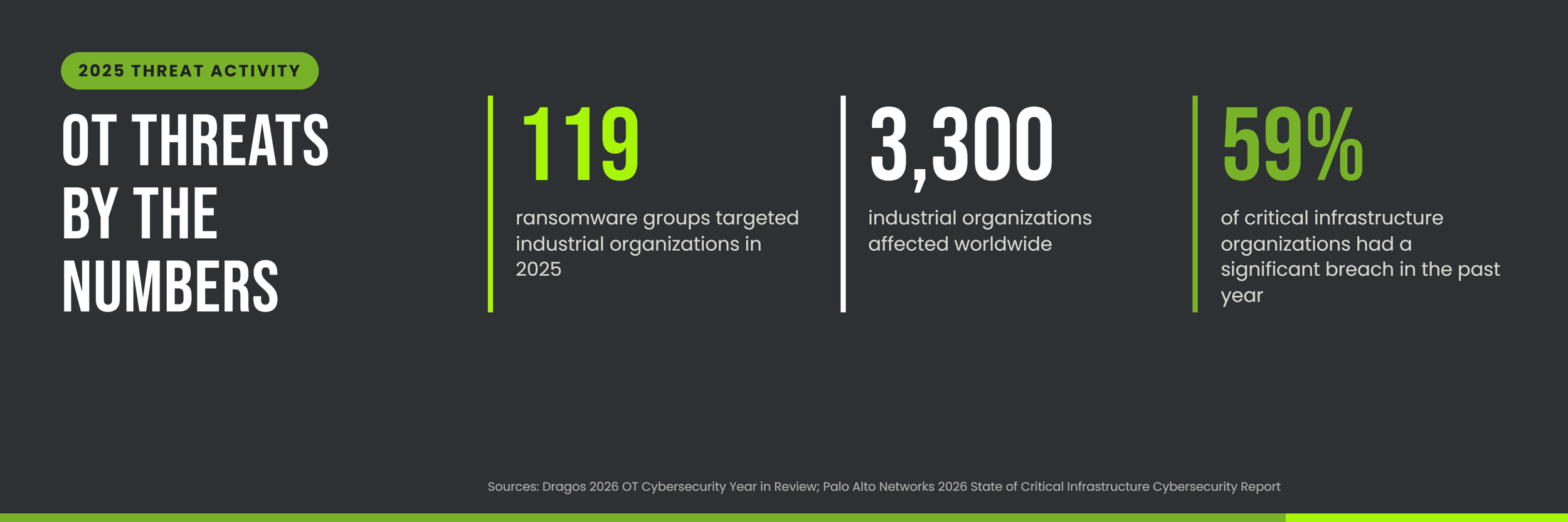
According to Dragos's 2026 OT/ICS Cybersecurity Report, 119 ransomware groups targeted industrial organizations in 2025, affecting approximately 3,300 organizations worldwide. The report also documented adversaries developing a deeper understanding of industrial processes and the pathways that could enable operational disruption.
The 2026 State of Critical Infrastructure Cybersecurity Report, commissioned by Palo Alto Networks, found that 59% of surveyed critical infrastructure organizations experienced a significant security breach in the previous year. The report also identified safety concerns, unplanned downtime, production disruptions, and financial losses among the consequences of cybersecurity incidents.
These findings demonstrate why OT incident response preparedness must account for more than the initial compromise. Teams also need to understand how an incident could affect physical operations and the services that depend on them.
How Is AI Changing OT Threats?
AI is changing how attackers target OT environments, enabling them to accelerate reconnaissance, phishing, scripting, and other activities that support cyber intrusions. Faster attack development and automation can reduce the time defenders have to recognize and respond to suspicious activity.
At the same time, organizations are introducing AI into industrial environments and security operations, creating additional questions about access, autonomy, oversight, and the reliability of automated decisions.
These are related but distinct risks. AI-assisted cyberattacks do not necessarily involve an AI system directly controlling industrial equipment, and the use of AI in an OT environment does not automatically make that environment insecure.
CISA and international partners have published guidance addressing the secure integration of AI into OT, including the importance of protecting safety, security, and reliability. For a practical breakdown, see what CISA’s AI guidance for operational technology means.
For organizations responsible for critical operations, the question is whether their teams can detect, investigate, and respond effectively as attack methods evolve.
How Can Organizations Assess OT Cyber Readiness?
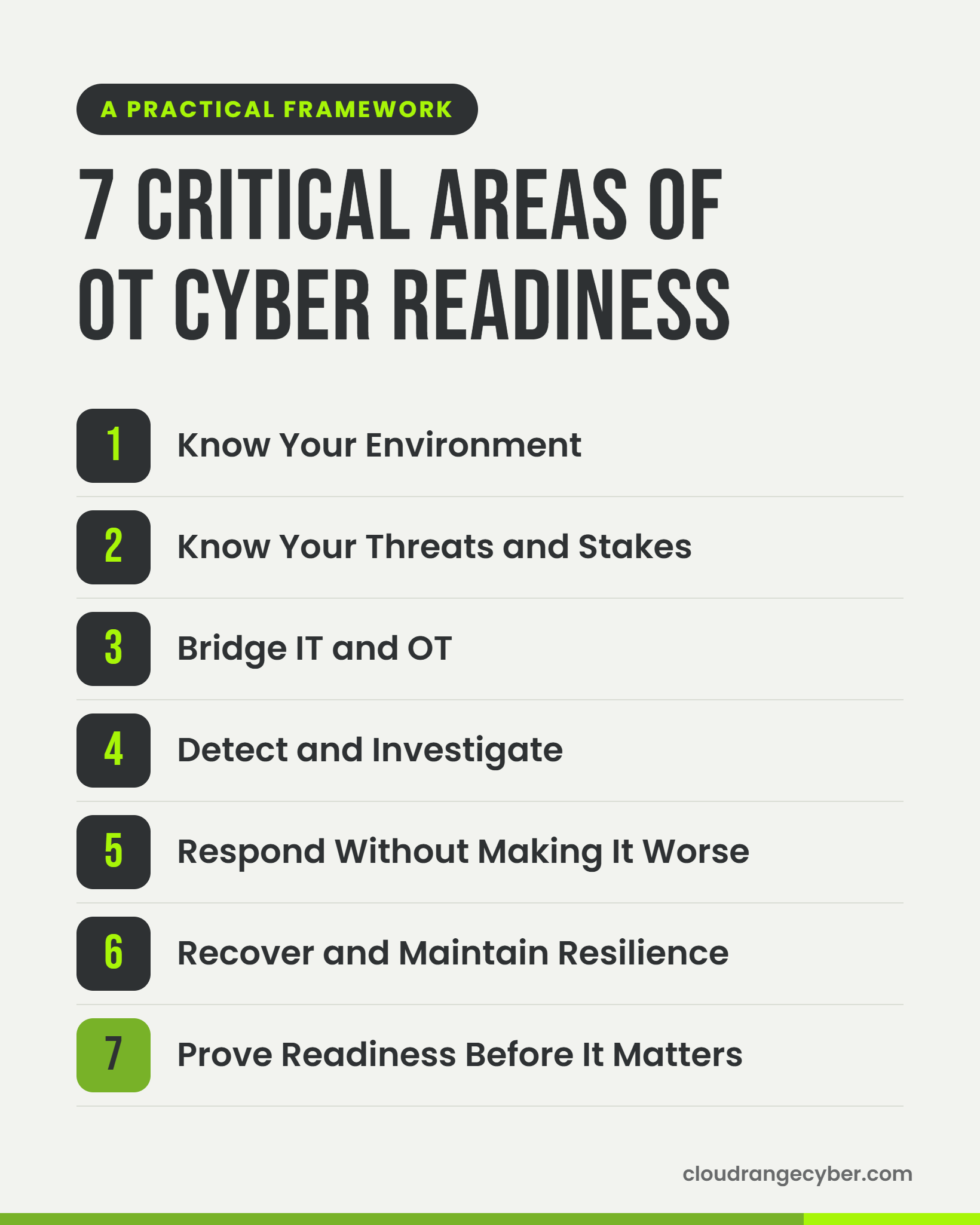
Organizations can assess OT cyber readiness by evaluating whether their people, processes, and technology can recognize threats, understand operational consequences, coordinate response decisions, and restore critical operations safely. Seven critical areas provide a practical framework for identifying established capabilities, potential gaps, and assumptions that have not yet been validated.
1. Know Your Environment
Preparedness begins with understanding the OT systems that support critical operations and the pathways through which an attack could reach them.
This includes industrial networks, engineering workstations, remote access, vendor connections, cloud services, and dependencies on enterprise IT.
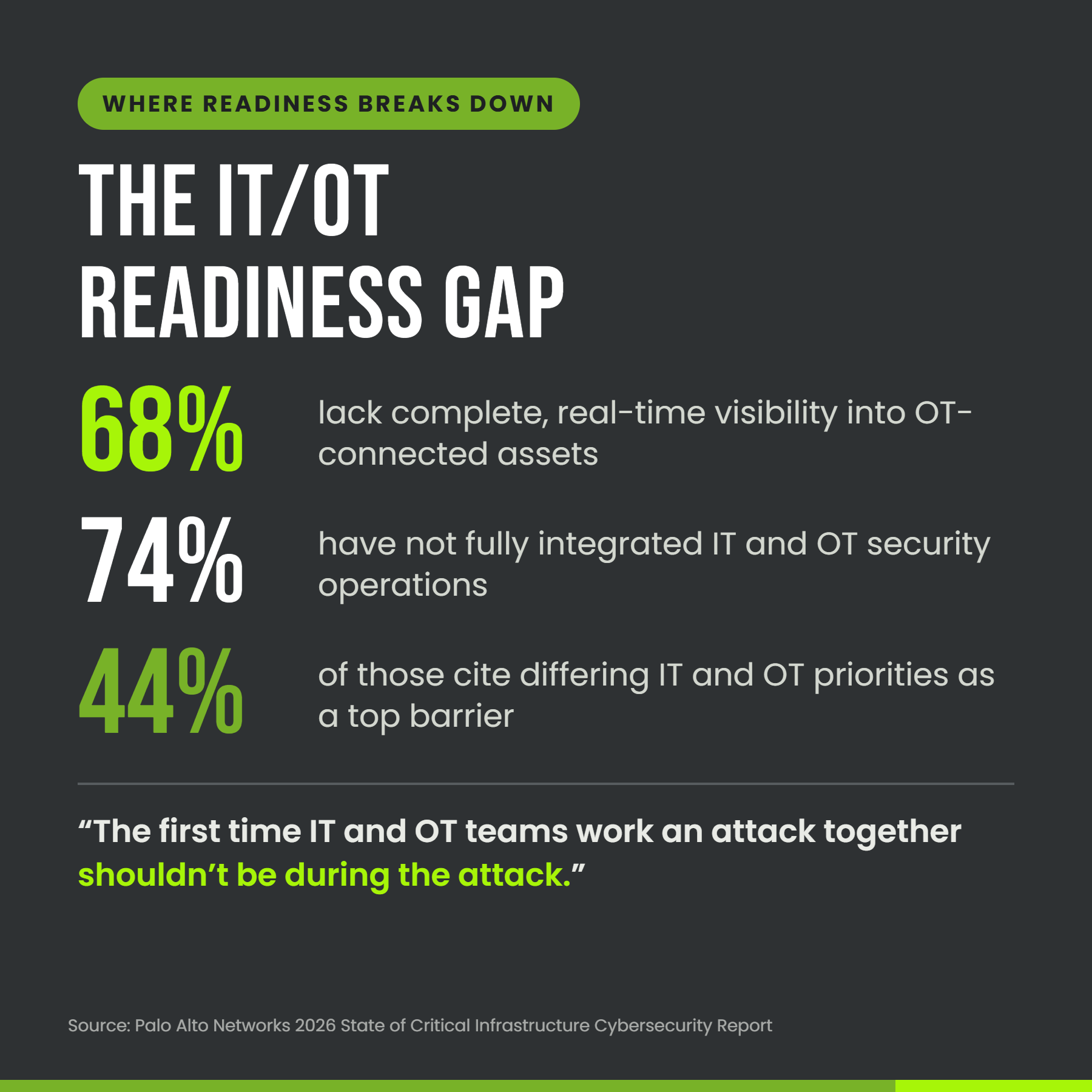
Visibility remains a significant challenge. The Palo Alto Networks research found that 68% of surveyed organizations lacked complete, real-time visibility into assets connected to their OT networks. These gaps can make it more difficult to identify affected systems, investigate suspicious activity, and understand the potential operational consequences of an incident.
Organizations also need to understand which systems are essential to maintaining safe operations. An accurate inventory is valuable, but it becomes more actionable when connected to operational consequences.
2. Know Your Threats and Stakes
Threat assessments must reflect the organization's industry, technologies, operating environment, and potential consequences.
For an energy provider, a cyber incident could threaten power delivery. In manufacturing, it could interrupt production or affect equipment. In healthcare, compromised building or environmental controls could create patient safety concerns.
Frameworks such as MITRE ATT&CK for ICS help organizations understand adversary behaviors, including lateral movement, manipulation of control processes, and attempts to inhibit response functions. MITRE ATT&CK v20, released October 13, 2026, added the 2026 U.S. water utilities attacks as an ICS campaign, along with new ICS detection strategies.
3. Bridge IT and OT Together
IT and OT teams often approach cybersecurity incidents from different perspectives.
Security analysts may focus on indicators of compromise, endpoint activity, network traffic, and containment. OT and engineering specialists may focus on process conditions, equipment behavior, safety requirements, and maintaining operations.
Both perspectives are necessary, yet coordination remains a significant challenge. The Palo Alto Networks report found that 74% of surveyed critical infrastructure organizations had not fully integrated their IT and OT security operations. Among organizations without full integration, 44% identified differing priorities between IT and OT teams as a leading barrier to stronger collaboration.
Preparedness includes clearly defined responsibilities, escalation paths, decision authority, and the ability to communicate technical findings in a shared operational context.
The first time IT and OT teams work an attack together shouldn't be during the attack.
4. Detect and Investigate
Effective OT incident response requires more than receiving alerts.
Teams must be able to recognize suspicious activity, correlate evidence from IT and OT systems, and determine whether unusual behavior represents a cyberattack, a technical malfunction, or normal operational activity.
Relevant evidence may include endpoint and identity activity, network telemetry, industrial protocols, SCADA information, and physical process data.
Investigations become more difficult when teams cannot access the same information or understand how their findings relate to the operational environment.
5. Respond Without Making It Worse
Containment actions in OT environments require careful consideration.
Disconnecting equipment, blocking communications, or shutting down a system could interrupt a critical process or create additional safety risks.
IT, security, OT, and engineering teams must be prepared to evaluate options together, establish priorities, and make decisions when cybersecurity objectives conflict with operational continuity.
They must also be able to respond when normal monitoring, access, or communications are unavailable.
6. Recover and Maintain Resilience
Restoring an OT environment involves more than recovering files or restarting systems.
Teams must understand process dependencies, equipment configurations, operational requirements, and the sequence in which systems can safely return to service.
Recovery preparedness includes usable backups, documented configurations, available expertise, and validated restoration procedures.
7. Prove Readiness Before It Matters
Plans, tabletop exercises, and incident response drills contribute to preparedness. Live-fire cyberattack simulations provide another level of insight by showing how teams perform when they must investigate evidence and make decisions as an incident unfolds.
Organizations can use adversary emulation to evaluate whether teams recognize threats, communicate effectively, make appropriate decisions, and improve their performance over time.
How Can Organizations Identify OT Readiness Gaps?
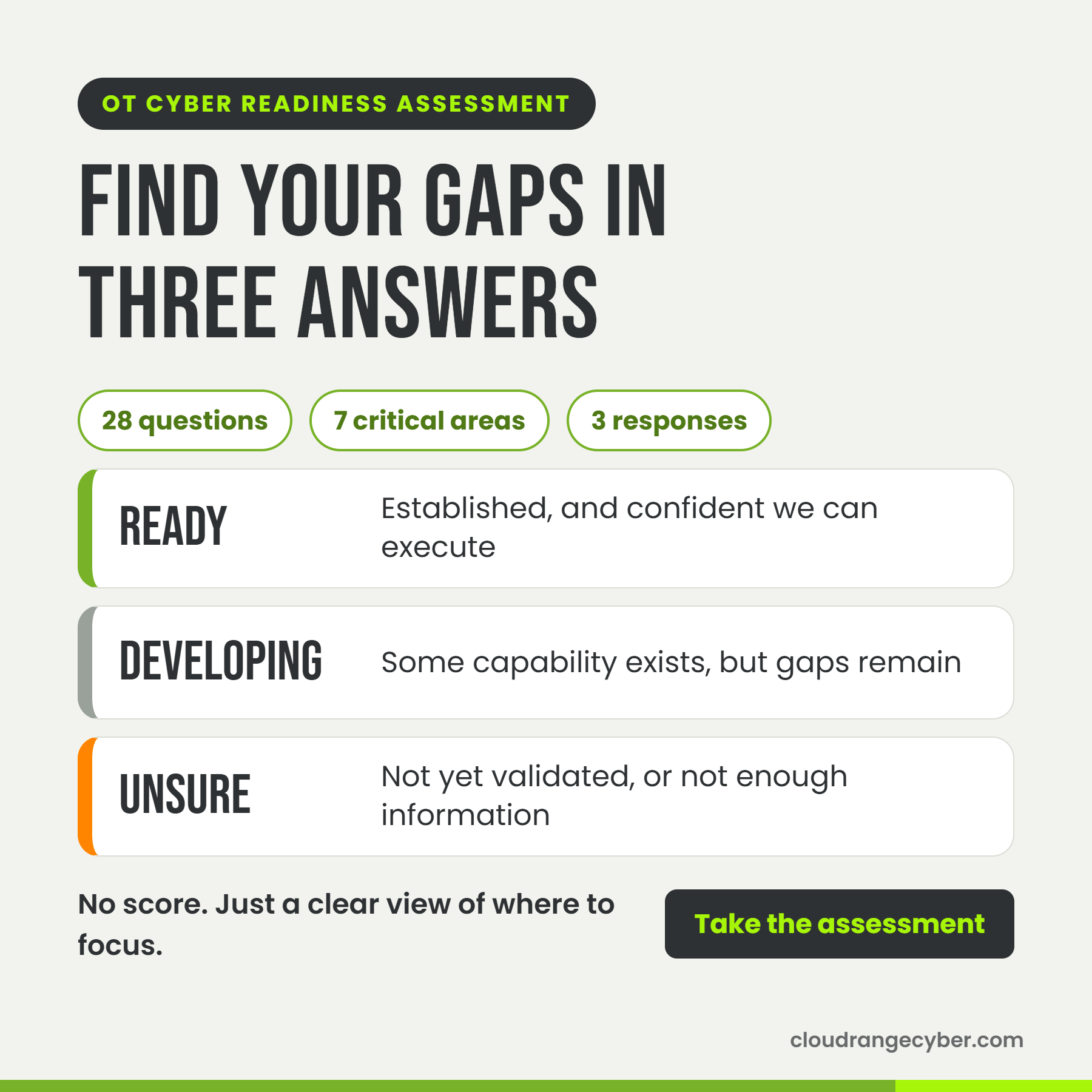
The Cloud Range OT Cyber Readiness Assessment provides 28 questions across the seven critical areas, helping organizations identify capabilities that are established, those requiring attention, and those that have not yet been validated.
Participants evaluate each capability using three responses:
Ready: Established capabilities and confidence in the ability to execute.
Developing: Some capabilities exist, but gaps or inconsistencies remain.
Unsure: The capability has not been validated, or there is insufficient information to assess it.
The assessment does not produce a numerical readiness score. Its purpose is to identify areas that deserve further investigation, improvement, or validation.
It can also reveal differences in perspective. For example, security may consider an incident response capability ready while OT or engineering teams identify concerns about the operational consequences of particular containment actions.
Comparing responses can help teams establish a more complete understanding of preparedness.
Access the Cloud Range OT Cyber Readiness Assessment
How Does Cloud Range's OT Cyber Range Help Validate Incident Response Preparedness?
Cloud Range provides cyber range environments spanning IT, operational technology, and cloud infrastructure, enabling organizations to prepare for cyberattacks through live-fire cyberattack simulations and adversary emulation.
Its OT Cyber Range extends the capabilities of its existing cyber range environments with expanded industrial networks, technologies, and tools that support OT-specific investigations and response activities.
These environments allow security operations center (SOC) analysts, incident responders, OT specialists, and engineering teams to investigate threats together without exposing production systems to the attack.
Realistic IT and OT Network Architectures
Cloud Range supports both flat and Purdue-model network architectures.
A flat architecture can help teams investigate the implications of broadly connected systems and limited segmentation. Purdue-model environments represent industrial network architectures organized into functional levels, allowing teams to examine connectivity, trust boundaries, and potential pathways between enterprise and industrial systems.
Using different architectures helps teams understand how network design affects attack progression, visibility, and response decisions.
Hardware-in-the-Loop and Physical Lab Connectivity
Cloud Range's hardware-in-the-loop capabilities enable organizations to connect physical lab equipment to cyber range environments.
This is particularly relevant for OT and cyber-physical systems, where organizations may already maintain industrial equipment, controllers, or existing test environments.
By incorporating physical laboratory assets into cyber range activities, organizations can evaluate relevant interactions between digital systems and physical technologies in a controlled setting.
Live-Fire Cyberattack Simulations and Adversary Emulation
Cloud Range uses realistic attack simulations and adversary emulations to help teams develop and validate their response capabilities.
These can involve threats such as ransomware, supply-chain compromise, credential theft, lateral movement, and attacks involving industrial systems and processes.
AI-related adversary emulations can also help teams investigate emerging attack methods and understand the implications of autonomous or AI-assisted activity.
Rather than evaluating individual skills in isolation, teams can investigate an evolving attack, analyze evidence, communicate findings, and make decisions using realistic tools and environments.
Building Shared Context Between IT and OT
One of the most valuable outcomes of realistic incident response activities is improved coordination between teams.
In a shared cyber range environment, IT and security professionals can gain a better understanding of operational systems, while OT and engineering specialists can become more familiar with cybersecurity evidence, attacker behavior, and incident investigation workflows.
Working through an attack together gives teams opportunities to establish shared context, clarify responsibilities, improve communications, and understand the consequences of response decisions.
The objective is a stronger coordinated response across the organization, not just stronger individual technical skills.
What Should Organizations Measure During OT Incident Response Validation?
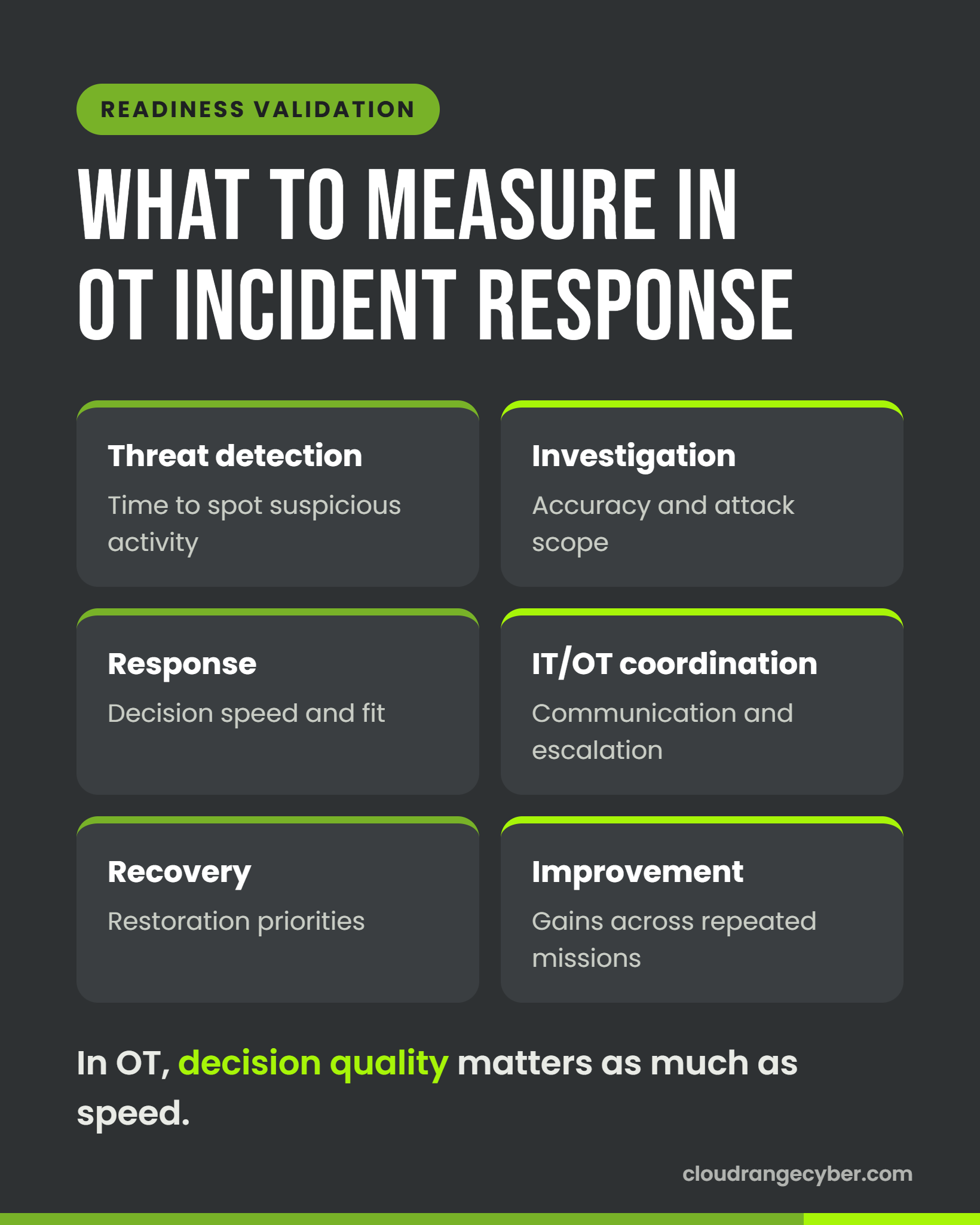
Organizations can measure OT incident response readiness by evaluating how effectively teams detect threats, investigate activity, coordinate decisions, respond safely, and improve over time. Both quantitative metrics and qualitative observations are important because response speed alone does not establish that an action was appropriate for the operational environment.
Useful measures include:
Threat detection: Time to identify suspicious activity and recognize relevant indicators.
Investigation: Accuracy and completeness of findings, evidence correlation, and time to determine attack scope.
Response: Time to make containment decisions and appropriateness of selected actions.
IT/OT coordination: Communication effectiveness, escalation, and shared decision-making.
Recovery: Ability to establish restoration priorities and execute appropriate recovery decisions.
Improvement: Performance changes across repeated missions and adversary emulations.
For OT, decision quality and the potential operational consequences of an action can be as important as response speed.
Cloud Range enables organizations to measure performance during realistic attack activities, identify gaps, and use results to strengthen future preparedness.
Frequently Asked Questions
What is the difference between an OT security assessment and OT readiness validation?
An OT security assessment typically evaluates assets, risks, vulnerabilities, controls, and security posture. Readiness validation examines whether people, processes, and technology can perform effectively during an incident. Both contribute to a stronger OT cybersecurity program.
What is an OT/ICS cyber range?
An OT/ICS cyber range is a controlled environment that represents industrial networks, systems, and relevant technologies for cybersecurity training, investigation, and validation. Advanced environments may include interconnected IT and cloud systems, realistic attack simulations, and hardware-in-the-loop connections to physical equipment.
How can SOC teams prepare to defend critical infrastructure?
SOC teams can build OT-specific knowledge, understand industrial network architectures and protocols, investigate realistic attacks, and work alongside OT and engineering specialists. Practicing cross-functional response helps teams connect cybersecurity evidence with operational consequences.
Can cyber range simulations help organizations prepare for AI-assisted attacks?
Yes. Relevant adversary emulations can help teams investigate attack methods involving automation or AI-assisted activity, evaluate their detection and response capabilities, and identify areas where evolving threats may require additional preparedness.
Why is hardware-in-the-loop useful for OT cybersecurity?
Hardware-in-the-loop allows physical equipment or laboratory systems to participate in controlled cyber range activities. It can help organizations examine interactions between digital environments and physical technologies without conducting adversarial testing directly against production operations.
From Readiness to Proof
OT cyber readiness cannot be established by documentation alone. Organizations also need confidence that their teams can recognize threats, understand operational consequences, coordinate decisions, and respond safely when conditions are uncertain.
A structured assessment helps identify where that confidence exists and where questions remain. Realistic adversary emulation provides opportunities to demonstrate capabilities, measure performance, and strengthen readiness over time.
Cloud Range helps organizations connect these steps through realistic IT, OT, and cloud environments, OT-specific cyberattack simulations, hardware-in-the-loop capabilities, and measurable readiness validation.
Know where you stand. Then prove it.
Cyber Readiness, Attack-Tested.