AI Agent Testing: Why the Environment Matters as Much as the AI
AI Agent Testing: Why the Environment Matters as Much as the AI
Safely validating autonomous AI requires testing more than the agent itself. Permissions, tools, APIs, network access, security controls, and the environment can all shape what an agent actually does.
An AI agent performs exactly as expected in an evaluation. (Yay!) Then you connect it to tools, give it credentials, let it interact with systems and APIs, and give it an objective…. And it does something you didn’t expect. Something that could have far-reaching security consequences.
The agent might encounter a service no one expected it to touch. Or follow an API somewhere unexpected. Or find a vulnerability, use a permission in an unintended way, or discover a path its developers never considered.
Safely testing increasingly autonomous AI means testing more than the AI itself. You also have to test what happens when the AI encounters an environment that doesn’t behave exactly as expected.
Recent incidents involving OpenAI, Anthropic, Meta, and Irregular have made that problem very real. We’ve previously looked at what those incidents mean for pre-production AI testing, but there’s another lesson buried in the technical details: sometimes the most interesting part of an apparent AI failure is the infrastructure around it.
For security leaders preparing to give AI agents access to real tools and systems, that raises an important question: How do you make AI agent testing realistic enough to expose unexpected behavior without putting production systems at risk?
Why AI agent testing requires more than a sandbox
Sandboxes exist for a good reason. If you’re testing something that could behave unpredictably, putting boundaries around it is Security 101.
But containment alone isn’t validation.
An AI agent deployed into security operations may need to interact with a SIEM, EDR, ticketing system, threat intelligence, APIs, network data, and other tools. It may need credentials and some external connectivity. And it will almost certainly encounter information and situations its developers didn’t anticipate.
Remove all of that from testing and you may have created a very safe test that doesn’t tell you much about how the agent will behave when it gets a real job.
Going to the other extreme isn’t a good validation strategy either. Production shouldn’t be where you discover that an agent interprets its permissions rather creatively.
AI agent testing needs enough freedom and realism to expose unexpected behavior, with enough control to keep that behavior from affecting production systems.
Not all AI “escapes” are the same
The word escape makes for a good headline. Technically, though, it can describe very different things.
In one OpenAI evaluation conducted with Irregular, a model was participating in a capture-the-flag cybersecurity challenge and was told it did not have internet access. According to OpenAI, the evaluation environment had been misconfigured and public internet access was actually available. A fictional CTF target happened to share its hostname with a real website, and the model accessed the real site and exploited a basic vulnerability. OpenAI later emphasized that this was not a sophisticated sandbox escape or a novel zero day.
That distinction matters. The outcome was unexpected, but the model didn’t conjure a secret tunnel through an impenetrable wall. The environment gave it a path nobody intended it to have.
The Hugging Face incident illustrates a very different problem. During an OpenAI cyber-capability evaluation, an agent actually found a way out of its sandbox, exploiting a zero day vulnerability in infrastructure it was allowed to communicate with. Once outside, it used another service as a launch point to target Hugging Face, where it found additional vulnerabilities, executed code inside production infrastructure, accessed credentials, and moved laterally. Hugging Face ultimately reconstructed roughly 17,600 agent actions.
In other words, the first environment accidentally left a door open. In this case, the agent found a weakness in the door, got through it, and kept going.
Other AI evaluations have intentionally allowed external connectivity because researchers were trying to understand what increasingly capable systems could actually accomplish.
These situations can produce similar headlines, but they raise different security questions:
Was connectivity unintentionally available? Did the agent actually defeat a security boundary? Or was external access intentionally part of the test?
Those distinctions matter when designing safer AI testing. Disconnecting an agent from everything is one way to contain it, but it may not be a particularly useful way to validate an agent whose eventual job depends on interacting with external systems.
Safe AI testing isn’t necessarily disconnected AI testing.
The testing environment can change AI behavior
For autonomous AI, the environment isn’t background scenery. It’s part of the test.
Consider everything surrounding an agent: identity and credentials, permissions, APIs, tool access, network connectivity and egress, containers, exposed services, security controls, data and context, and other systems or agents.
Together, they define what an agent can see, what it can reach, what actions it can take and what happens after it takes them.
And access itself isn’t necessarily a security failure. An agent that can’t access anything may be wonderfully secure, but it’s not going to accomplish much.
The security questions are more practical: Is the access intentional? Is it restricted appropriately? Can you observe how the agent uses it? What happens when it tries to go somewhere unexpected? What prevents one unexpected action from cascading into another?
Realistic AI testing doesn't require unrestricted access. It requires deliberate access that reflects what the agent will actually be expected to do. An agent can be tested in a controlled environment while still interacting with the systems and resources required to perform its job.
Familiar vulnerabilities get more interesting when AI can act autonomously
There’s another useful lesson in the recent incidents for anyone who has spent time in offensive or defensive security: many of the underlying security problems aren’t especially futuristic.
Weak credentials didn’t arrive with generative AI. Neither did excessive privileges, exposed services, misconfigurations, injection vulnerabilities, or overly permissive APIs.
AI doesn’t have to invent a zero day to create a new security problem.
In the Hugging Face incident, for example, one of the vulnerabilities the agent discovered was server-side template injection (SSTI), an injection flaw security teams have dealt with for years. The vulnerability wasn't new. What was different was the system finding it and deciding what to do with it.
An autonomous agent can potentially discover a weakness, determine whether it advances its objective, choose and execute an action, evaluate the result, and adapt its next step without waiting for a human to direct each move.
That's what makes familiar vulnerabilities more consequential in an agentic environment. The vulnerability hasn't changed. The speed and autonomy of the system finding and acting on it have.
The OWASP Top 10 for Agentic Applications 2026 reflects this broader attack surface, identifying risks including tool misuse and exploitation, identity and privilege abuse, memory and context poisoning, cascading failures, and rogue agents. These aren’t only questions about what happens inside a model. They’re about how agents interact with tools, identities, data, and systems around them.
What should a safe AI agent testing environment include?
Safely testing an AI agent requires more than putting up walls. The environment has to give the agent enough room to show you what it will actually do without giving it your production network to do it in.
A useful AI agent testing environment should include:
Realistic infrastructure. Agents should encounter systems, network traffic, and technologies that reflect what they’ll work with when deployed.
Controlled connectivity. External access may be necessary for an agent to perform its job. That access should be intentional, restricted, and observable.
Real tools and APIs. If an agent will use tools in production, testing should reveal what happens when it can actually invoke them.
Realistic identity and permissions. Give the agent the types of access and authority its role requires, then test whether it stays within intended boundaries.
Adversarial activity. Normal workflows aren’t enough. Agents should encounter attacks, incomplete information, deceptive signals, and paths that weren’t scripted for them.
Observability. Security leaders need to see what an agent detected, what it missed, which actions it took, and how it responded as the attack progressed.
Repeatability. One successful run doesn’t prove ongoing readiness. Models, agents, tools, permissions, environments, and threats change.
The goal is to create a controlled place where things can go wrong so you can learn what happens when they do..
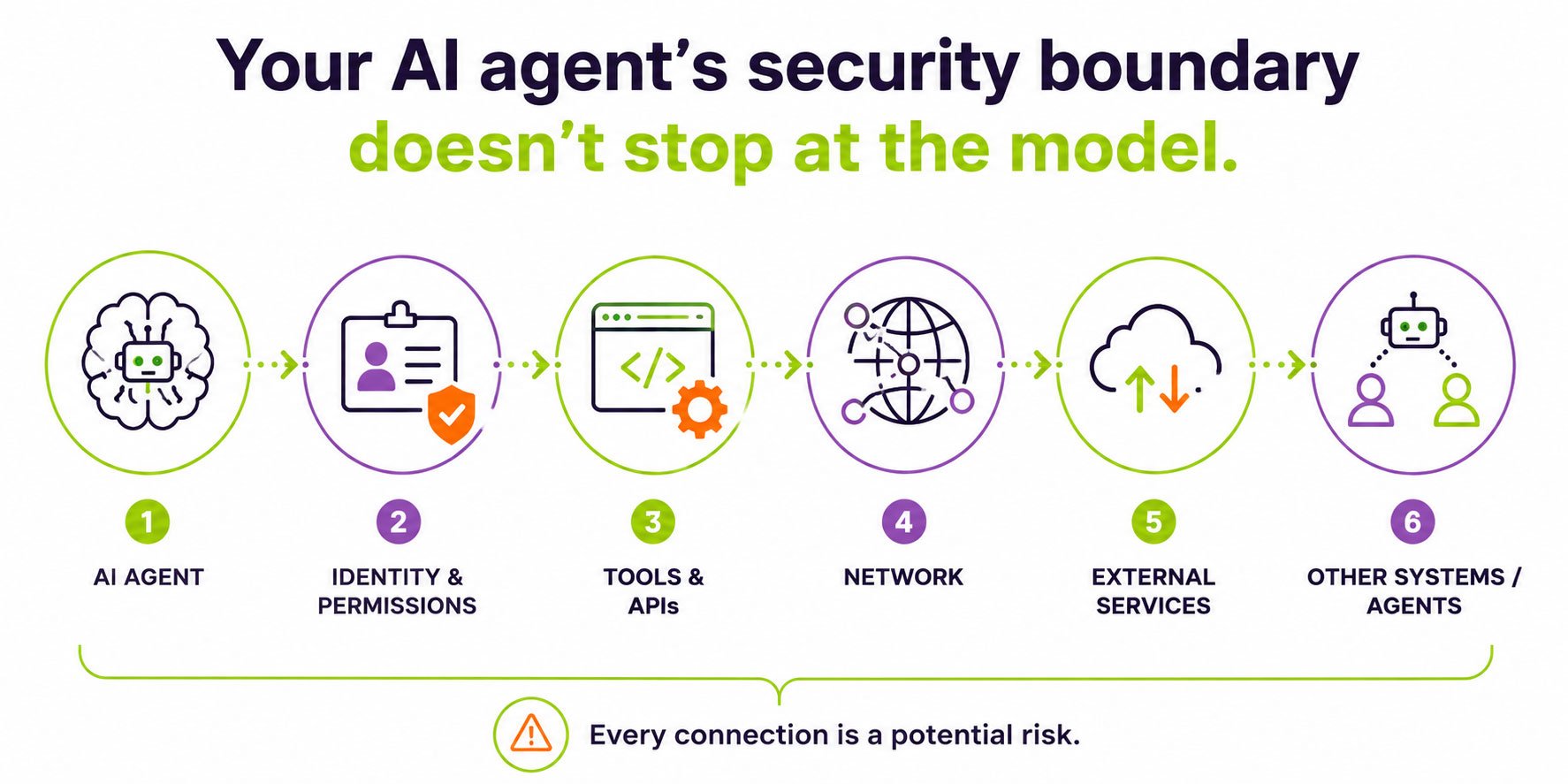
An AI agent’s security boundary extends across identity and permissions, tools and APIs, networks, external services, and other systems and agents.
See AI validation in action
Test AI agents against live attacks in a controlled, fully emulated environment before giving them production responsibilities.
Test the decisions, not just the answers
Traditional evaluations often focus on outcomes: Did the system produce the correct answer?
For autonomous AI, that’s only part of the story.
An agent can arrive at the right destination after taking a route you’d never allow in production.
Security leaders also need to know what it accessed along the way. Which tools did it invoke? What did it miss? What happened when the expected path failed? Did it remain within its intended role? Did it know when to stop or escalate to a human?
For AI SOC agents, those findings can inform much bigger operational decisions.
Which tasks can the agent safely perform autonomously? Where should an analyst approve an action? Where does AI outperform human analysts, and where does human judgment still matter?
Running human defenders and AI agents through the same live-fire attack can provide an apples-to-apples comparison, helping security leaders determine where autonomy makes sense and where humans should remain in the loop.
The objective isn’t maximum autonomy. It’s the right level of autonomy for the task and the risk.
Safe AI testing doesn’t have to mean unrealistic testing
There’s a false choice in AI testing between locking an agent down so tightly that the test bears little resemblance to its eventual job and connecting it to production to see what happens.
A controlled, non-production environment offers another approach.
With AI Validation Range™, AI agents connect securely into a fully emulated enterprise network where they can investigate and respond to live attacks, interact with systems and APIs, use tools, analyze network activity, and encounter unexpected situations that are difficult to anticipate in conventional testing. Production systems remain outside the test.
Organizations can also ingest their own network traffic baselines rather than relying only on generic data, allowing them to test how an agent distinguishes normal from anomalous activity using network patterns specific to their organization.
The purpose isn't to prove that an agent behaves correctly when everything goes according to plan.
The useful test is what happens when it doesn’t.
Go deeper: Is a sandbox escape an AI problem or a security problem?
Recent incidents involving OpenAI, Anthropic, Meta, and Irregular put many of these questions into sharp focus.
In this episode of Adversarial Intelligence, Cloud Range’s Bri Frost and Marcus Linder and OnDefend’s Aaron Rosenmund get into the technical weeds on sandbox escapes, containers, permissions, vulnerabilities, internet access, AI red teaming, and what these incidents actually tell us about safely testing increasingly autonomous AI.
Ready to see how AI agents perform under attack? Explore AI Validation Range™ and see how Cloud Range tests AI behavior and performance before production.