
5 Things to Know About Device Code Phishing
If you've ever signed into Netflix on a new TV, activated Spotify on a gaming console, or authenticated GitHub CLI or Azure CLI on your laptop, you've almost certainly used device code authentication.
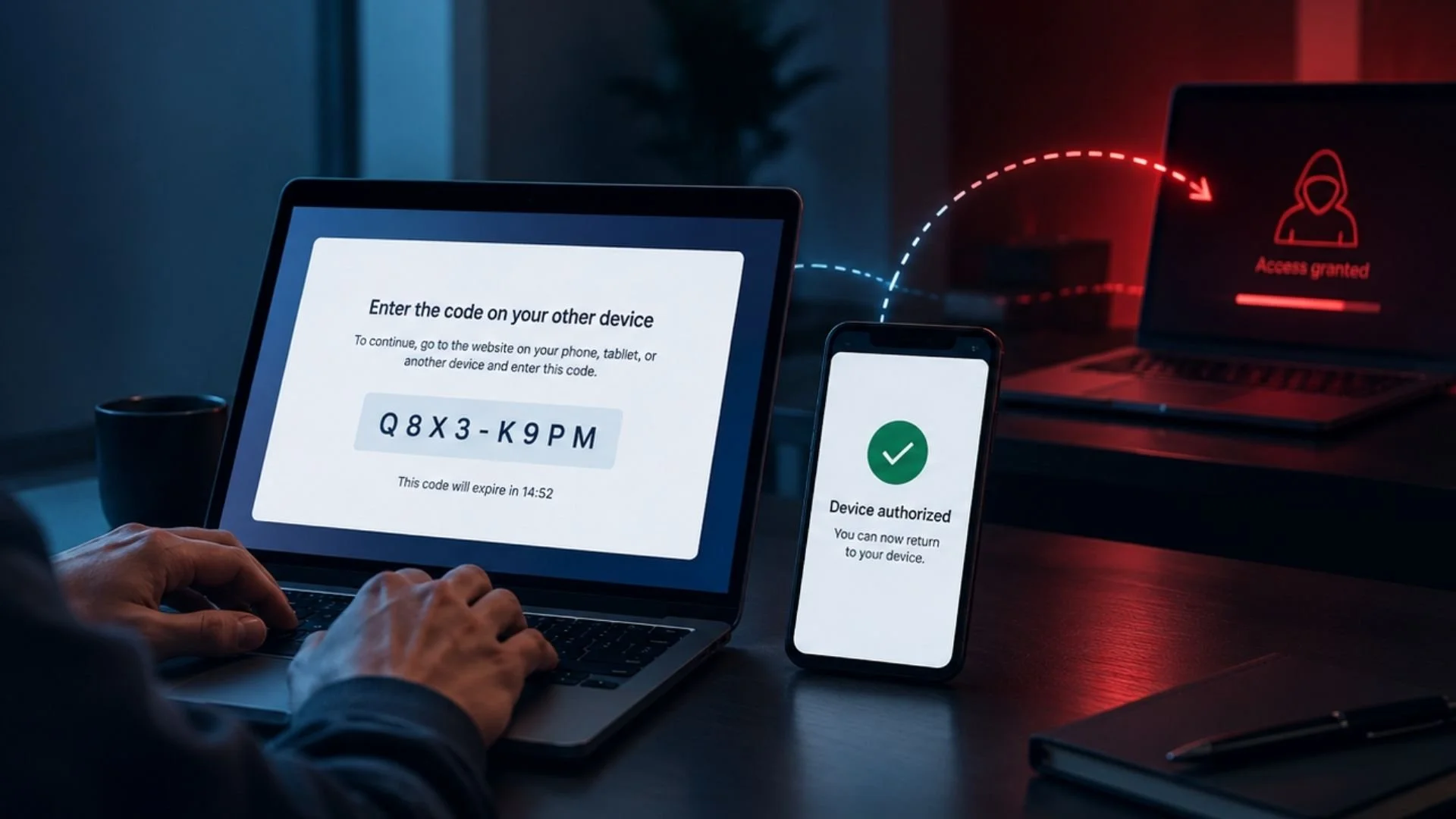
Rather than typing a long password into an awkward interface, you're shown a short code. You then visit the legitimate login page on a different, previously authorized device, enter the code, and you're signed in. The problem is that threat actors have realized they can hijack that same workflow to authorize their own devices instead of yours.
Device code phishing is an identity attack that exploits this legitimate device authorization workflow, tricking a user into authorizing an attacker-controlled device or application.
Attackers' growing use of this technique has helped propel device code phishing into the fastest-growing threat of 2026. The release of dedicated phishing toolkits for these attacks in late 2025, combined with AI-assisted development, has dramatically lowered the barrier to building convincing attack infrastructure. Device code phishing means that attackers don't necessarily need fake login pages, stolen passwords, or MFA bypass to compromise an account.
Here are five things every security team should understand about device code phishing.
1. It Happens After Authentication
Perhaps the biggest misconception surrounding device code phishing is that it's another technique for bypassing multi-factor authentication. It isn't. In fact, MFA usually works exactly as intended, and yet attackers can still successfully take over an identity.
That's because device code phishing doesn't attack the authentication process itself. Instead, it abuses what happens immediately afterwards. Authentication answers the question, "Who are you?" Authorization answers, "Now that we know who you are, what are you allowing this application or device to do on your behalf?"
In a normal device code flow, those two stages occur back-to-back. The user successfully authenticates, then authorizes a trusted device or application to access their account. Device code phishing abuses the second part of this.
Essentially, an attacker initiates a legitimate OAuth 2.0 Device Authorization Grant flow to a legitimate service, from a device they control. They then receive a valid device code from the identity provider.
Social engineering begins when they trick the victim into completing the authorization for the device they control, on the provider's genuine login page (usually with a crafty email or text). If the victim completes the authorization, the attacker receives tokens that can provide access to the victim's account, including any data and other services that the compromised account has access to.
2. It Rewrites the Phishing Playbook
Device code phishing means the user isn't entering their credentials into a cloned website or handing an MFA code to a man-in-the-middle proxy. Instead, they're completing a legitimate authorization workflow that ultimately grants access to an attacker-controlled device.
The difference becomes clearer when compared with OTP phishing. In a conventional OTP phishing attack, the attacker steals a one-time password generated for the victim (by tricking them into disclosing it, for example, on a fake login page) and immediately reuses it to authenticate themselves.
In device code phishing, the attacker first initiates a legitimate device authorization request, receives a valid code from the identity provider, and then persuades the victim to complete that authorization on their behalf. Rather than authenticating to a fake service, the user unknowingly authorizes the wrong device on a genuine service.
That distinction has important implications for user awareness. Much of the security guidance organizations have reinforced over the past decade has centred on helping users identify fraudulent websites: inspect the URL, check the domain, look for spelling mistakes, avoid entering credentials into unfamiliar pages. Those remain valuable habits, but device code phishing demonstrates that they no longer address every identity threat.
3. The Most Convincing Attacks Exploit Legitimate Enterprise Workflows
Device code phishing is effective not only because of how the technology works, but because the workflow often feels familiar to users.
Traditional phishing campaigns ask users to do something unusual like open an unexpected attachment, log into a suspicious website, or bypass a browser warning. Device code phishing, on the other hand, often asks victims to perform an action that's entirely consistent with their normal working day. Entering a short code into Microsoft's device login page or authorizing a GitHub CLI session isn't inherently suspicious if it's something you've done dozens of times before.
This is particularly relevant in developer-heavy environments. Device authorization is widely used to authenticate command-line tools and applications that don't present a traditional browser-based login experience. Azure CLI has long relied on the device code flow for authentication, GitHub CLI uses it as its default sign-in method, and AWS CLI has supported similar workflows.
Engineers, DevOps teams, cloud administrators, and platform engineers therefore become accustomed to seeing prompts asking them to visit a legitimate login page and enter a short authorization code. That familiarity dramatically reduces the cognitive friction attackers need to overcome.
That challenge becomes even more pronounced as modern enterprises continue adopting cloud-native development practices. The potential attack surface is expanding as organizations rely on more:
Developer tooling
APIs
Infrastructure-as-Code platforms
Cloud consoles
AI coding assistants
Third-party integrations that authenticate through OAuth and delegated authorization
Every real business workflow built around trust, convenience, and rapid authentication has the potential to become an opportunity for social engineering if users lose sight of why they're authorizing access.
The evolution of the attack itself reflects this growing maturity. Early device code phishing campaigns suffered from a practical limitation: attackers had to generate a device code before sending the phishing email, giving victims only a short window (typically around 15 minutes) to complete the authorization before the code expired.
But now, phishing-as-a-service platforms can dynamically generate fresh device codes the moment a victim clicks the initial lure, allowing campaigns to remain effective regardless of when the email is opened.
That has transformed device code phishing from a niche tactic into one that can be reliably automated and delivered at scale. Crowdstrike’s 2026 Threat Hunting Report illustrates just how quickly the threat has grown, reporting a 15x spike in monthly device code phishing attempts.
4. You Can't Simply Disable Device Code Authentication
An obvious question follows from the rise and success of these attacks: Why not just disable device code authentication altogether? In some environments, that may be possible. But for many organizations, that’s a complicated and often infeasible choice.
That’s because the OAuth 2.0 Device Authorization Grant exists to solve legitimate authentication challenges. Devices with limited input capabilities, command-line tools, remote management utilities, and cloud administration workflows all depend on the device code flow to provide a secure way of authenticating users without embedding credentials directly into applications.
Microsoft Entra, GitHub CLI, Azure CLI, AWS CLI, and numerous third-party applications either support or rely on device code authentication in different ways. Removing it entirely may therefore break legitimate business processes.
The challenge is compounded by the fact that device code authentication isn't implemented consistently across platforms. Google Workspace, for example, presents a relatively smaller attack surface because Google deliberately restricts which OAuth scopes are available through the device authorization flow. High-value Workspace APIs such as Gmail and Calendar cannot simply be accessed via device code authentication.
Microsoft's implementation is broader. Device code flows can request a wider range of permissions, while Microsoft's ecosystem also introduces identity features such as Family of Client IDs (FOCI) and Primary Refresh Tokens (PRTs) that can increase the value of a successful compromise. GitHub sits somewhere in the middle: broad repository permissions are available, but attackers generally need to control their own OAuth application and the victim is presented with an explicit consent screen before access is granted.
There is no universal defensive playbook. A mitigation that works well for one platform may be impractical (or impossible) for another. Security teams therefore need to resist the temptation to search for a single technical control that eliminates the problem altogether.
Instead, the focus should shift towards managing where and how the feature is used. Security teams can start by understanding whether device code authentication is genuinely needed across their environment or whether its use is limited to particular users, applications, or administrative functions. Where possible, Conditional Access policies, application consent controls, restrictions around OAuth scopes, and tighter governance of high-risk apps can all reduce unnecessary exposure without disrupting legitimate workflows.
5. Device Code Phishing Requires a Different Kind of Attack Simulation
You simply might not know whether your analysts, processes, and tooling are capable of recognizing an attack like this in real time. That’s understandable. Device code phishing is a relatively new technique that doesn't resemble the phishing attacks many SOCs have historically trained against. If your incident response playbooks still assume credential theft, fake login pages, or other social engineering attacks, they might not adequately prepare analysts for an attack built entirely around legitimate identity workflows.
Simulation is about exercising your security teams against the techniques adversaries are actually using today. By incorporating identity-centric attack scenarios such as device code phishing into realistic, live-fire cyber range simulations, you can evaluate whether analysts identify suspicious OAuth activity, whether response procedures contain token-based compromises quickly enough, and whether existing detection logic produces meaningful alerts rather than overwhelming noise.
You can validate both preventative controls and operational response under realistic conditions.
Can analysts recognize suspicious OAuth authorizations?
Do your alerts provide enough context to investigate quickly?
Can compromised tokens be identified and revoked before the attacker achieves their objectives?
Those are questions that policies and architecture diagrams alone can't answer.
Cloud Range enables security teams to validate their readiness against device code phishing and other emerging cyber threats through realistic, live-fire attack simulations. Teams can test detection and response, identify gaps, and measure how effectively both human analysts and AI agents perform under real-world attack conditions in a fully customizable cyber range environment.