How MCP and AI Agents Are Changing Shadow IT
How MCP and AI Agents Are Changing Shadow IT
Model Context Protocol (MCP) is quietly changing how AI agents interact with enterprise systems, creating new visibility gaps and execution risks that traditional shadow IT models were never designed to address.
When you think of shadow IT, the scenarios that probably jump to mind are your marketing team spinning up a SaaS tool without telling IT or an employee storing sensitive files in a personal Dropbox account. Maybe, with the emergence of AI chatbots, you’ve heard about instances of employees pasting customer data into ChatGPT or teams experimenting with copilots outside policy guardrails.
But AI agents are fundamentally changing what shadow IT looks like inside the enterprise. AI systems are no longer confined to generating text or summarizing documents. Increasingly, they observe, decide, and act. They open tickets, query databases, modify files, and trigger workflows. Much of that shift is being driven by the protocol layer that allows AI systems to act inside business environments.
Why MCP Changes Enterprise Risks
To understand why Model Context Protocol (MCP) matters, you first have to understand what it actually does, without getting lost in protocol details. MCP is the connective tissue that allows AI systems to interact with real business tools.
Before MCP-style integrations, AI mostly produced output for a human to act on. A chatbot could draft an email, suggest a SQL query, or summarize a document, but someone still had to copy, paste, approve, and execute.
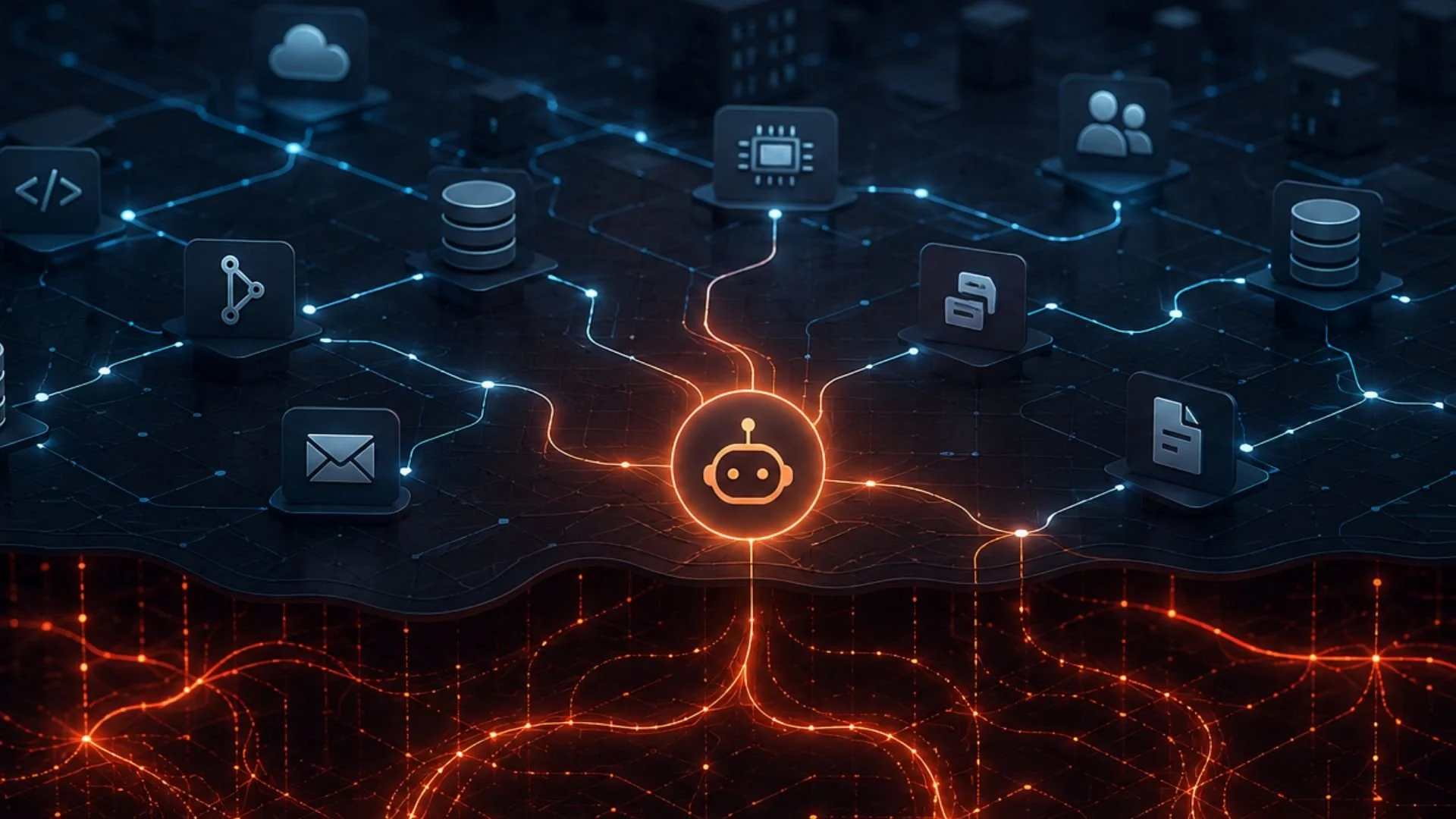
Model Context Protocol changes that dynamic. It provides a standardized way for AI applications and agents to connect to business tools such as Jira, GitHub, databases, file systems, CI/CD pipelines, and CRM platforms. AI agents can then understand what those tools do and interact with them directly. Instead of hard-coding a fixed integration between “AI” and “System X,” MCP servers describe capabilities in human-readable language such as:
“Create Jira ticket”
“Query customer database”
“Deploy build to staging”
“Modify configuration file”
An AI agent can dynamically evaluate those descriptions, decide which tool is relevant to a given task, and execute it, sometimes chaining multiple tools together in sequence. That’s what makes modern AI agents feel operational rather than conversational. That is where AI shifts from assistance to operational authority – and the enterprise risk model changes.
The Visibility Problem
In many companies, Model Context Protocol servers are installed locally inside developer environments, added to AI-enabled tools, or pulled from public registries with minimal friction (there are currently over 22,000 of them available at the time of writing). Once connected, the agent can immediately begin using the exposed tools.
That’s where visibility breaks down. Traditional integrations typically pass through architectural review, credential scoping, and centralized monitoring. They are registered, documented, and observable. MCP integrations often aren’t.
A developer can connect an MCP server to an agent, and the integration simply works. The server inherits whatever permissions or credentials the environment already has. The agent begins invoking tools.
No central system may even record that the connection exists. This is what creates Shadow MCP. It’s not necessarily malicious intent, but untracked execution authority. You could have an inventory of AI systems and an inventory of enterprise tools, yet lack visibility into the integration layer connecting them.
When security teams can’t see which agents are connected to which MCP servers, and what those servers expose, they struggle to accurately model the true attack surface. And that’s before adversarial behavior even enters the equation.
Execution Authority Gets Centralized
MCP servers sit between AI agents and multiple downstream systems. A single MCP server may have access to your:
File systems
Internal ticketing systems
CI/CD pipelines
CRM or ERP platforms
Configuration management tools
It becomes a shared bridge – a concentrated execution point. If credentials are over-scoped, reused, or insufficiently segmented, that bridge can amplify impact. What looks like a minor misconfiguration in isolation can become a cross-system escalation path when an agent invokes actions autonomously and at scale.
Standardization Lowers Friction (and Lowers Guardrails)
Model Context Protocol’s strength is that it standardizes integration. It makes it easy to connect agents to tools. It reduces custom glue code and accelerates experimentation.
But MCP servers can be installed directly into developer environments such as VSCode or Cursor. They inherit the permissions of the user who installs them. And many developers already operate with broad local privileges, API keys, and tokens on their machines.
The integration works immediately. The agent can use the tools immediately. Security teams may never know the connection exists.
Shadow MCP Creates Unknown Authority
Shadow IT used to be about unknown tools going beyond the purview of your IT or security teams. But with MCP in the mix, it’s more like unknown authority.
You may have full visibility into:
Your AI platform
Your enterprise applications
Your identity providers
And still lack visibility into the connective layer that determines how those systems interact. Ultimately, MCP acts as the bridge between natural-language processing and privileged system execution, allowing AI agents to convert interpreted intent into direct operational actions.
How Threat Actors Could Exploit Shadow MCP
Here’s how this unknown authority could be exploited:
Tool Poisoning
If someone connects an MCP server inside your environment without formal review, you probably don’t have a precise understanding of what authority that server exposes.
Because MCP tools are described in natural language, attackers don’t necessarily need to break authentication or exploit a vulnerability. They can manipulate how a tool is described so that an agent selects or chains it in unintended ways. If you don’t know that server exists or you haven’t reviewed how its tools are defined, then you don’t really know the boundaries of what your AI agent can do.
Redirecting Your Agent’s Authority
Because MCP servers sit between your agents and your business systems, an attacker doesn’t need to compromise the downstream systems directly.
If they can get a shadowed or lookalike MCP server installed, or intercept calls through a proxy, your agent may start routing privileged operations through infrastructure you don’t control. From your logs, it may look like normal automation. The agent is still doing what it was designed to do.
But its authority is now being exercised through an adversarial layer. If you never inventoried that integration path, you wouldn’t know to look for it.
Session Hijacking
In a governed integration, your security team knows which MCP servers are connected, which identities they use, and how authentication flows are configured. In a Shadow MCP scenario, you don’t.
If a locally installed MCP server uses OAuth tokens or inherited credentials, and that server was never formally reviewed, then you may not even know which tokens are being issued or where they’re stored.
If an attacker hijacks that session or captures those tokens, they’re exploiting authority that was already active in your environment, just not visible to you.
From a detection standpoint, the activity may look legitimate. The agent is issuing valid commands and the tokens are valid. The logs may be on a developer’s machine, not in your SIEM. The difference is that the execution path was never modeled.
Understanding Agent Behavior Before It Matters
Shadow MCP expands the enterprise attack surface. But it also expands the cognitive burden on security teams. When agents can dynamically discover tools, interpret metadata, and autonomously invoke operations across systems, detection logic built for traditional API abuse is no longer sufficient.
If Shadow MCP is becoming an execution layer risk across the enterprise, then security teams themselves must understand how agents behave before they attempt to monitor or defend them. If agents are becoming operational actors inside your environment, then you need to see what they do.
Security teams need controlled environments that mirror enterprise reality, where AI systems can be red-teamed, stressed with attacker-driven scenarios, evaluated for anomalous execution patterns, and tested for data leakage or unsafe outputs before those behaviors influence production systems.
Cloud Range’s AI Validation Range provides a controlled environment to evaluate AI behavior with confidence, before that behavior exercises authority across MCP integrations and real enterprise systems.