How Agentic AI Is Changing Cloud Security

How Agentic AI Is Changing Cloud Security
Agentic AI is changing cloud security by introducing autonomous identities that can make decisions, invoke tools, access data, and take actions across cloud environments. Security controls therefore have to account not only for who or what has access, but whether an AI agent’s actions remain appropriate once that access has been granted.
When businesses first embraced the cloud, cybersecurity underwent major changes. Network perimeters dissolved, identity replaced location as a primary security boundary, and practices such as Zero Trust, cloud security posture management, and continuous monitoring emerged to address a fundamentally different computing model.
Agentic AI represents another shift. Agentic AI refers to AI systems that can independently plan, make decisions, use tools, and take actions to accomplish a goal. As these AI agents become part of cloud environments, security controls designed around human users and predictable workloads have to account for systems that can reason, adapt, and act autonomously.
These changes extend into security operations as well. As AI agents take on roles in security operations, security leaders also have to determine how to measure their performance and readiness alongside human defenders.
Key Takeaways
Agentic AI expands cloud security beyond identity and access because security controls also have to account for the decisions and actions AI agents take after access is granted.
AI agents create a new kind of machine identity shaped by delegated authority, tool access, data access, autonomy, and human accountability.
Cloud observability increasingly needs to connect infrastructure telemetry with agent decisions, tool use, permissions, and resulting actions.
Threat detection has to distinguish legitimate autonomous behavior from compromised or inappropriate agent behavior that may occur through valid identities and systems.
Data security controls should remain outside the AI model, with authorization and deterministic guardrails governing what agents can access and expose.
1. How Does Agentic AI Change Zero Trust?
Agentic AI extends Zero Trust beyond verifying identity, devices, and sessions. Organizations also have to consider whether an AI agent's actions remain appropriate for its delegated objective and current operating context.
Zero Trust aims to strengthen enterprise security by shifting trust away from network location and toward continuous verification of identities, devices, and sessions. But it was largely conceived around human users and deterministic workloads whose behavior is relatively predictable once appropriate access has been granted.
AI agents introduce a different operating model. They interpret objectives, reason through possible approaches, invoke tools, retrieve external data, and adapt their behavior as circumstances change.
That means verifying an agent's identity and permissions is only part of the equation. Security controls also have to determine whether the action an agent has decided to take is appropriate in the current context.
Before an agent executes an API call, retrieves sensitive data, invokes another agent, or performs a business action, runtime policy controls can evaluate whether that decision aligns with organizational policy, the agent's delegated objective, and the current operating context. Trust becomes something that must be evaluated throughout execution, particularly before consequential actions.
Continuous monitoring is already part of what CISA defines as “optimal” Zero Trust maturity. Agentic AI extends what needs to be monitored. In addition to identities, devices, and sessions, organizations increasingly have to account for the decisions autonomous agents make during execution.
Permissions may need to evolve as well. Static role-based permissions can become blunt instruments when an autonomous agent performs many different tasks throughout the day. More dynamic, task-scoped permissions can limit an agent to the specific tools, datasets, and APIs required for its current objective and revoke that access when the task is complete. Sandboxing and controlled execution environments can further limit the impact if an agent is compromised or behaves unexpectedly.
2. Why Do AI Agents Create New Cloud Identity Risks?
AI agents create new cloud identity risks because their identity is connected not only to what they can access, but also to what they have been authorized to do and how independently they can act.
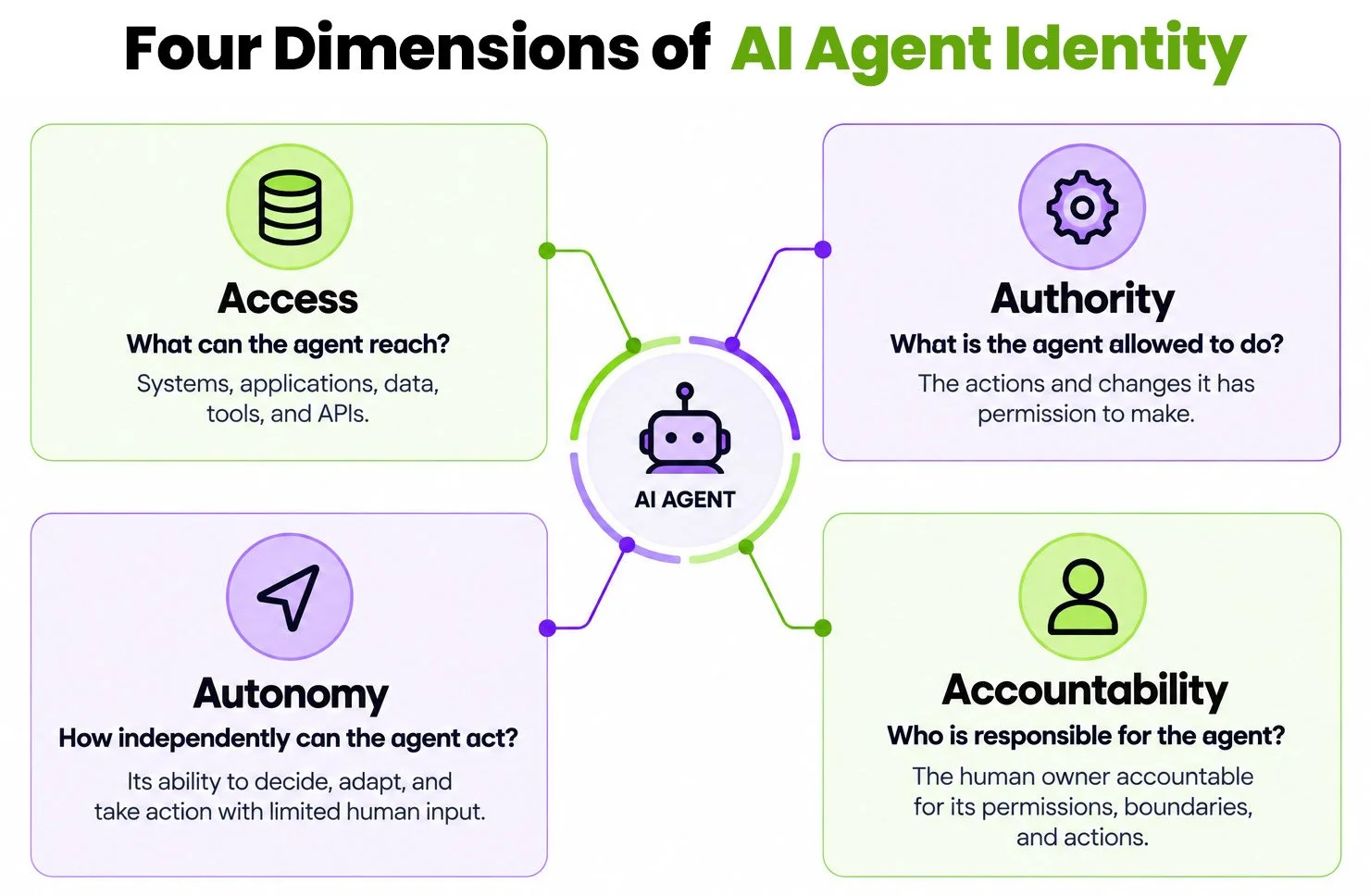
Cloud environments already contain a growing number of machine identities, including service accounts, applications, containers, and automated workloads. AI agents add another layer because their identity is tied not only to what they are allowed to access, but also to what they have been delegated to do.
This is creating new challenges for existing identity systems. Research from the Cloud Security Alliance found that most identity systems were built for humans rather than self-directed, API-driven agents operating continuously at runtime. Its research also points to issues including static credentials, fragmented authorization, limited discovery, and weak traceability as organizations deploy autonomous agents.
An organization may eventually operate hundreds or thousands of agents that are created dynamically, updated through prompt changes, granted new tool access, or instantiated on demand to complete individual tasks. An agent's behavior can change without new code being deployed, while its permissions, prompts, tools, and objectives may evolve continuously.
That makes agent inventory, ownership, and accountability increasingly important. These issues become particularly important as agents gain greater access, authority, and autonomy, expanding the potential attack surface around their identities and actions. Organizations need visibility into:
Agent inventory: Which AI agents exist?
Ownership: Who is responsible for each agent?
Access: Which systems and data can the agent access?
Tools: Which tools and APIs can it invoke?
Autonomy: What level of independent action has it been granted?
Accountability: Which human owner is accountable for its permissions and actions?
Trust boundaries become equally important. A customer support agent may legitimately query CRM records and draft responses, but it has no reason to interact with payroll systems. Identity controls, network segmentation, narrowly scoped API permissions, and runtime policy enforcement can help keep an agent's actions within its authorized boundaries.
The shift is subtle but important: securing machine identity is no longer only about authenticating a workload. With AI agents, security also has to account for delegated authority and the actions that authority enables.
3. What Does Agentic AI Change About Cloud Observability?
Agentic AI expands cloud observability from understanding what occurred in the infrastructure to understanding the decisions, permissions, tools, and context behind an autonomous agent's actions.
Cloud-native architectures transformed observability over the past decade. Security teams became accustomed to monitoring containers, serverless functions, Kubernetes clusters, cloud APIs, and identities through increasingly rich telemetry.
AI agents introduce information that traditional infrastructure logs alone may not explain.
Consider an agent that accesses an unusual dataset and then calls an external API. Infrastructure telemetry can show that both events occurred, but understanding whether the behavior was legitimate may require additional context: What objective was the agent pursuing? What information influenced its decision? Which tools did it select? Which policies were evaluated? What action did it ultimately take?
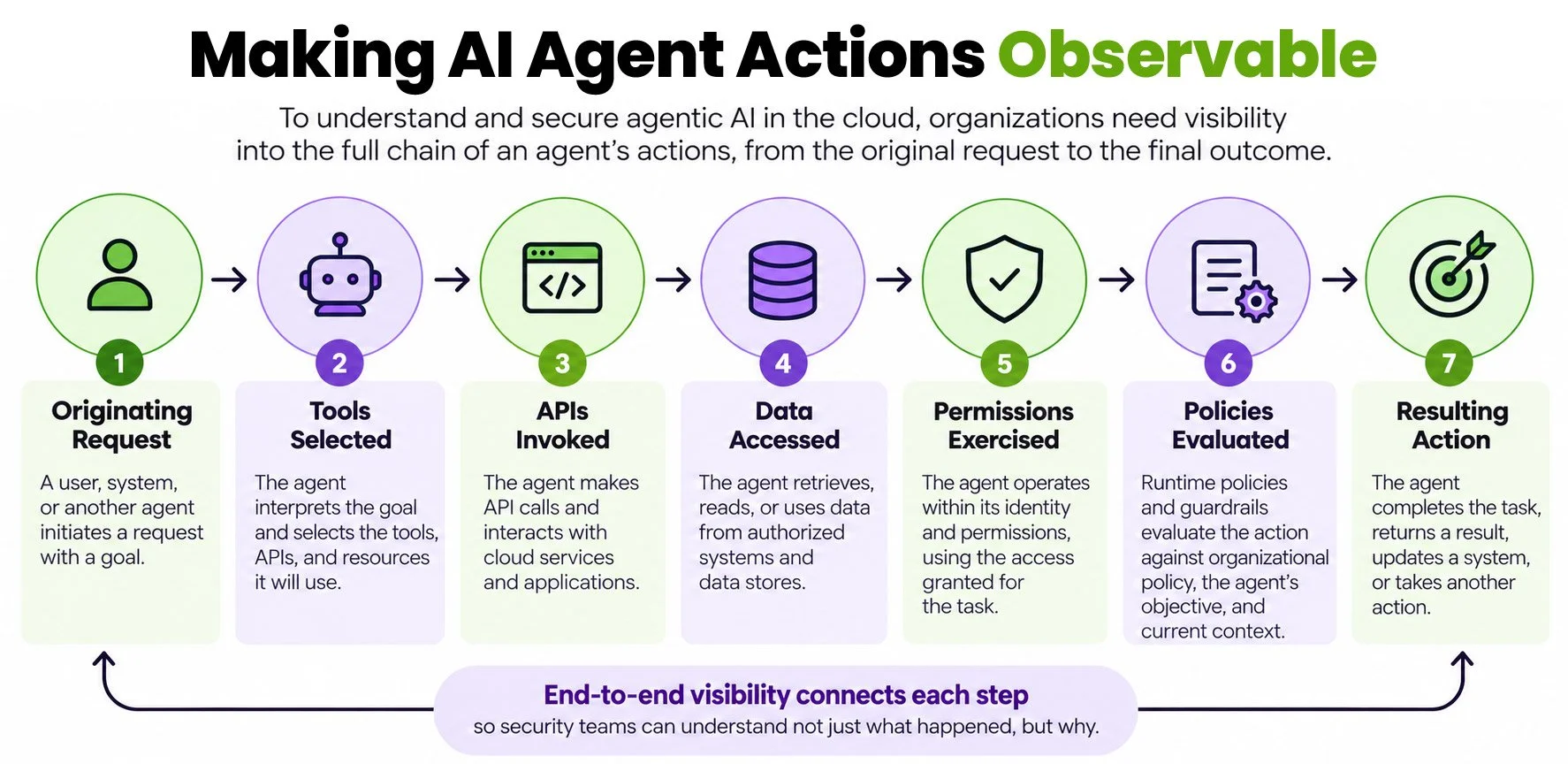
Security teams therefore need visibility that connects infrastructure activity with agent activity. Significant actions may need to be traceable across:
Originating request
Tools selected
APIs invoked
Data accessed
Permissions exercised
Policies evaluated
Resulting action
This aligns with Google's security principles for AI agents, which include well-defined human controllers, limited agent powers, and observable agent actions. Google specifically emphasizes making agent activity transparent and auditable through logging and clear characterization of actions.
That visibility also matters for governance. As organizations deploy agentic workloads into regulated cloud environments, they may need to reconstruct decision chains and demonstrate that controls were functioning, permissions were appropriately delegated, and autonomous actions remained within organizational policy.
In an agentic cloud environment, observability increasingly means being able to understand not only what happened, but why an autonomous system took the action it did.
4. How Does Agentic AI Complicate Cloud Threat Detection?
Agentic AI complicates threat detection because legitimate autonomous behavior can resemble malicious activity, while inappropriate agent actions can occur through valid identities, credentials, and systems.
User and Entity Behavior Analytics (UEBA), anomaly detection, and behavioral analytics depend on establishing a baseline and identifying activity that deviates from it.
Agentic AI complicates the definition of normal.
A coding agent may legitimately make thousands of API calls in rapid succession, access hundreds of files, invoke multiple tools, and complete tasks in minutes that would take a human several hours. To a detection system calibrated around human behavior or more predictable workloads, that activity could resemble compromise even when the agent is functioning exactly as intended.
The reverse is also possible. An agent operating within valid credentials and approved systems could take an inappropriate action that does not trigger conventional indicators of compromise.
That makes context increasingly important to cloud detection. The same agent may exhibit very different behavior depending on its objective, the prompt it receives, the tools available to it, or the systems it has been asked to interact with.
Effective detection will increasingly require connecting security telemetry with operational context. An API call that appears routine from an application perspective could represent a scope violation when viewed against an agent's assigned objective or permitted actions.
The goal is not simply to identify unusual agent activity. It is to distinguish legitimate autonomous behavior from behavior that falls outside the agent's intended operating boundaries.
That distinction is one of the areas security leaders can evaluate using the AI Agent Readiness Check, which focuses on six questions around agent behavior, boundaries, performance, and readiness before granting production authority.
5. Why Can't the AI Model Be the Data Security Boundary?
AI models should not become the final security boundary for enterprise data because generative models are probabilistic. Authorization and deterministic controls can enforce what information an agent is permitted to retrieve, use, or expose.
Cloud computing shifted enterprise data toward centralized stores exposed through APIs. AI agents build on that model by retrieving information from multiple cloud platforms, reasoning over it, combining it, and presenting results back to users.
That creates an important security distinction.
In traditional cloud applications, the application itself often serves as an enforcement point. If a user is not authorized to view a customer record, financial report, or HR file, the application does not return it. With agentic AI, information may be retrieved from multiple systems, combined by a model, and returned through a natural-language interface.
A system prompt telling an agent to “only return data the user is authorized to access” is not a substitute for access control. Prompts can be manipulated through adversarial input or result in unintended behavior.
Authorization therefore needs to remain outside the model. Existing role-based access control (RBAC) or attribute-based access control (ABAC) policies can determine what information an agent is permitted to retrieve before that information reaches the model. Ideally, the model never becomes the component responsible for deciding what a user is allowed to see.
The same principle applies when data leaves the model. As organizations give agents permission to update CRM records, modify cloud resources, execute workflows, or interact with SaaS platforms, deterministic controls can inspect and restrict sensitive information before it reaches an end user or another system.
Generative AI is probabilistic by design. The controls protecting sensitive enterprise data do not have to be.
Testing those controls also requires looking beyond the model itself. The environment in which an AI agent operates can influence what it can access, how it behaves, and what happens when something goes wrong.
From Cloud Security to Agent Readiness
Agentic AI does not replace the cloud security principles organizations have spent years developing. It changes how some of those principles have to be applied.
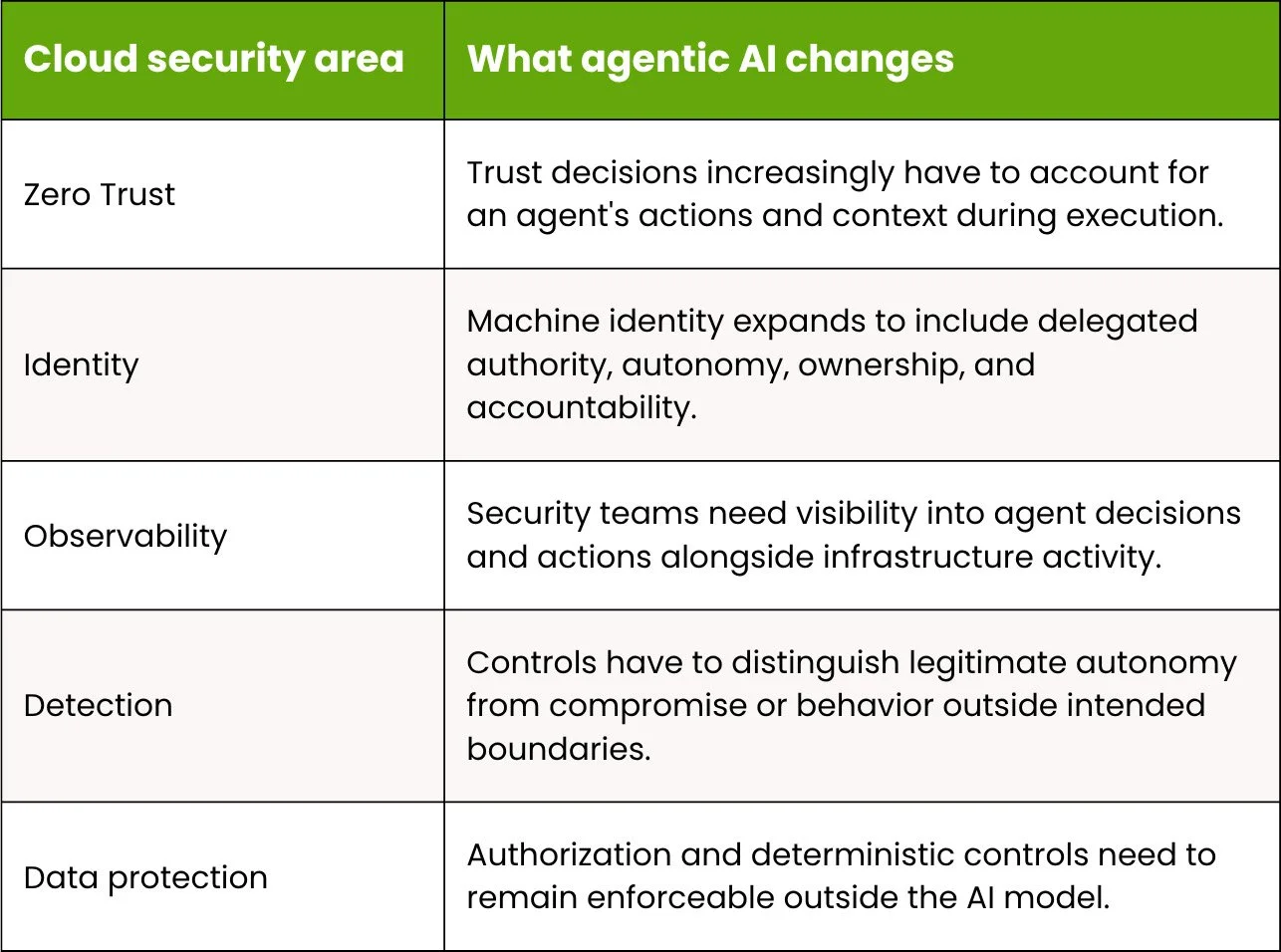
The shift can be summarized across five areas:
There is also a common question beneath all of these controls: Will they work when an AI agent encounters conditions you did not anticipate?
That is difficult to answer from configuration and policy alone. Before an agent is trusted with sensitive data, privileged access, or consequential actions, organizations can test how it behaves when faced with adversarial inputs, conflicting signals, unexpected conditions, and realistic attacks.
Cloud Range's AI Validation Range provides a controlled environment for testing AI models and agents against realistic enterprise infrastructure and security conditions. Organizations can red team models, test for sensitive data leakage, evaluate agent behavior and guardrails, and validate performance before deployment and on an ongoing basis.
Want to go deeper on securing agentic AI?
Download the Cyber Readiness Guide for Agentic AI for a practical look at the risks, controls, and validation considerations organizations need to address as AI agents gain greater access and autonomy.
Frequently Asked Questions
What is agentic AI?
Agentic AI refers to AI systems that can independently plan, make decisions, use tools, access data, and take actions to accomplish defined goals. AI agents are individual systems that use these capabilities to perform tasks with varying levels of human oversight.
How does agentic AI change cloud security?
Agentic AI introduces autonomous identities and workloads that can make decisions and take actions across cloud systems. Cloud security therefore has to account not only for agent identity and access, but also for permissions, behavior, tool use, data access, runtime decisions, and the context in which actions occur.
How is AI agent security different from traditional cloud security?
Traditional cloud security largely protects users, applications, workloads, infrastructure, and data. AI agent security adds the need to secure autonomous behavior, including what an agent is authorized to do, which tools and data it can access, how its decisions are monitored, and whether its actions remain within defined boundaries.
What cloud security controls are important for AI agents?
AI agent security can involve identity and access controls, task-scoped permissions, agent inventory and ownership, runtime policy enforcement, logging and observability, network segmentation, data authorization, and controls that limit sensitive information exposure.
How can organizations test AI agents before deployment?
Organizations can test AI agents in controlled environments that replicate realistic infrastructure, security tooling, data, and attacks. Testing can evaluate how agents respond to adversarial inputs, unexpected conditions, sensitive data, changing signals, and attempts to push them outside their authorized boundaries.