How Do You Know When an AI Agent Is Ready for More Autonomy?
How Do You Know When an AI Agent Is Ready for More Autonomy?
AI agents can investigate alerts, analyze telemetry, interact with security tools, access enterprise data, and increasingly take action with limited human involvement. The harder question for security leaders is not what AI can do. It is what the organization has enough evidence to trust it to do on its own.
As AI becomes more deeply integrated into security operations, AI agent readiness becomes a risk decision. Greater autonomy may be appropriate for some tasks, while others still require human approval or judgment. The difference should be based on demonstrated performance, not assumptions.
Key Takeaways
AI capability and AI readiness are not the same thing.
The risk of an AI agent depends on its access, authority, autonomy, and the potential impact if something goes wrong.
Successful pilots and task-based testing do not necessarily show how an agent will behave under unexpected or adversarial conditions.
Validation can provide evidence for deciding where AI can operate independently and where human oversight remains important.
AI readiness changes as models, permissions, integrations, responsibilities, and threats change.
Why Doesn't Successful AI Testing Prove Readiness?
Testing whether an AI agent can complete its intended task is important. But successful task completion answers only part of the question.
An agent may perform well with expected inputs and familiar workflows but behave differently when telemetry is incomplete, signals conflict, an attacker introduces deceptive information, or the agent encounters a situation it has not seen before. In security operations, those aren't edge cases. Uncertainty and adversarial behavior are part of the operating environment.
That is why there is an important distinction between testing and validation:
Testing asks: Did it work?
Validation asks: Can we trust it?
Testing can confirm that an AI performs particular tasks or behaviors. Validation goes further by building evidence about operational performance across both expected and unexpected conditions. For security teams evaluating AI for operational use, a structured process to validate an AI agent before it runs in the SOC can help turn that distinction into practical decisions about readiness.
For an AI agent that provides information for an analyst to review, that distinction matters. For an agent that can change a configuration, trigger a workflow, reset credentials, or take another action without approval, it matters considerably more.
What Determines the Risk of an AI Agent?
The same AI capability can carry very different levels of risk depending on what the agent has been allowed to access and do.
Four factors help put that risk into context:
Access: What systems, tools, identities, and data can the AI reach?
Authority: What decisions can it influence, and what actions can it take?
Autonomy: What can it do without human review or approval?
Impact: What could happen if it makes the wrong decision, takes the wrong action, exposes information, or is manipulated?
An AI assistant that recommends a response for an analyst to approve presents a different risk than an agent authorized to execute that response across production systems. As access, authority, autonomy, and potential impact increase, so does the importance of having evidence that the agent's performance supports that responsibility.
This also means autonomy does not have to be an all-or-nothing decision.
An organization may have enough evidence to allow an agent to act independently on one type of task while requiring human approval for another. Over time, responsibilities can expand as performance improves and risk becomes better understood.
These considerations extend beyond the SOC. As we've explored in How Agentic AI Is Changing Cloud Security, AI agents introduce a new kind of machine identity shaped not only by access, but by delegated authority, autonomy, and human accountability.
What Should You Validate Before Giving an AI Agent More Autonomy?
Before expanding an agent's responsibility, security leaders need evidence of more than whether it usually gets the right answer.
Operational validation can examine several dimensions of performance:
Accuracy: Are the agent's decisions correct across a range of realistic conditions?
Performance: How effectively does it perform its intended tasks under operational conditions?
Consistency: Does it continue to perform reliably with different inputs and environments?
Limitations: Where does it struggle, and what failure modes or blind spots emerge?
Risk: What are the potential operational, security, or business consequences when it fails or is misused?
Readiness: Does the evidence support the responsibility and autonomy the organization intends to give it?
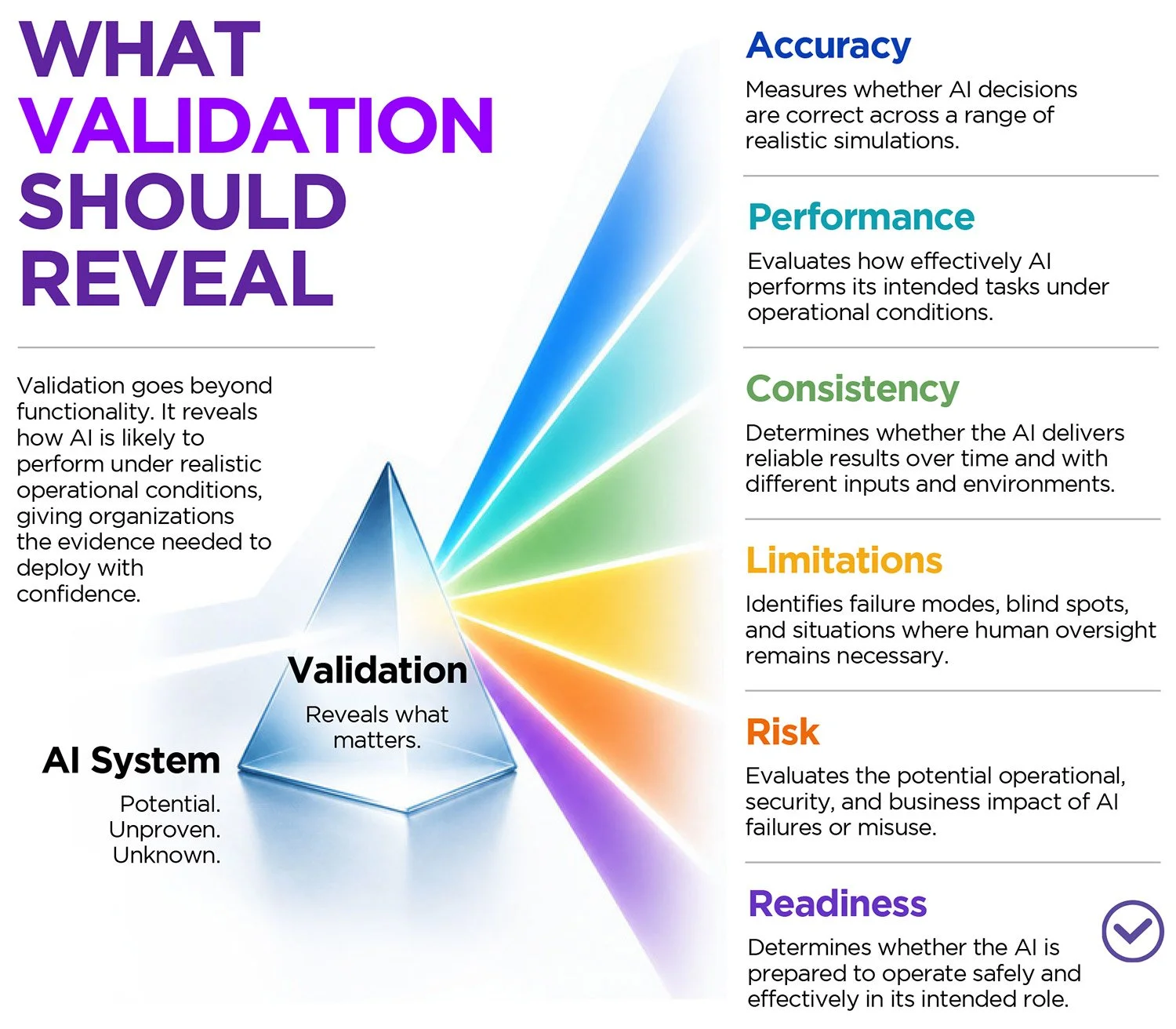
The goal isn't to prove that an AI agent never fails. It is to understand where it performs well, where it doesn't, and what level of responsibility its demonstrated performance supports.
That evidence gives security leaders a stronger basis for answering practical questions: Is the agent ready for its intended role? What can it do independently? Where should approval remain mandatory? Which failure modes are unacceptable? What needs to improve before its responsibility expands?
For AI operating in the SOC, this is ultimately a question of operational readiness for agentic AI, not merely whether a pilot or demonstration was successful.
Why Does the AI Testing Environment Matter?
An AI agent's performance can depend heavily on the environment around it.
Generic test data can establish baseline capabilities, but it may not show how an agent performs with the security tools, network traffic, workflows, access, and operational complexity it will encounter in practice.
As we've explored in more depth, the AI agent testing environment matters as much as the AI. The closer testing reflects the agent's intended operating context, the more relevant the evidence becomes. That can mean exposing the agent to incomplete or conflicting telemetry, unfamiliar attack techniques, deceptive signals, adversarial inputs, changing workflows, and situations where it must determine whether to act or escalate.
It also means giving AI somewhere to fail without learning those lessons in production.
An agent that retrieves information it was never expected to access, takes an unintended action, or follows an unexpected path toward a legitimate objective can expose an important limitation. Finding that behavior during validation gives an organization the opportunity to change permissions, controls, training, or oversight before the same behavior creates operational consequences.
How Much Human Oversight Does an AI Agent Need?
There is no universal level of human oversight that is right for every AI agent. Oversight should reflect the agent's demonstrated performance, its level of autonomy, and the potential consequences if it gets something wrong.
An agent may outperform people in speed, scale, or consistency for certain tasks while human judgment remains important when context, ambiguity, or higher-impact decisions are involved.
That is one reason benchmarking human and AI performance under the same conditions can be valuable. The objective isn't to determine whether humans or AI are “better.” It is to understand the strengths and limitations of each and determine where automation, human judgment, or a combination of the two produces the best outcome.
For security leaders, that turns human oversight from a general principle into something that can be informed by performance evidence.
Why Isn't AI Readiness a One-Time Decision?
Even strong validation results have a shelf life.
Models are updated or retrained. Agents gain access to new tools and data. Permissions expand. Workflows change. Responsibilities increase. New attack techniques emerge. Any of those changes can affect how an AI agent performs and whether the evidence that supported an earlier readiness decision still applies.
Continuous validation creates a performance history that can show whether an agent is improving, remaining consistent, or beginning to drift. It can reveal whether training is improving results, whether model or workflow changes affect performance, and whether greater autonomy continues to be supported by the evidence.
AI readiness isn't permanent. It must be continuously proven.
Cloud Range's AI Validation Range™ provides a non-production enterprise environment where organizations can train, test, validate, and benchmark AI models and agents under realistic and adversarial conditions and continue measuring performance as AI and its responsibilities evolve.
Is Your AI Ready for More Responsibility?
Before giving an AI agent greater access, authority, or autonomy, organizations should be able to answer some basic questions.
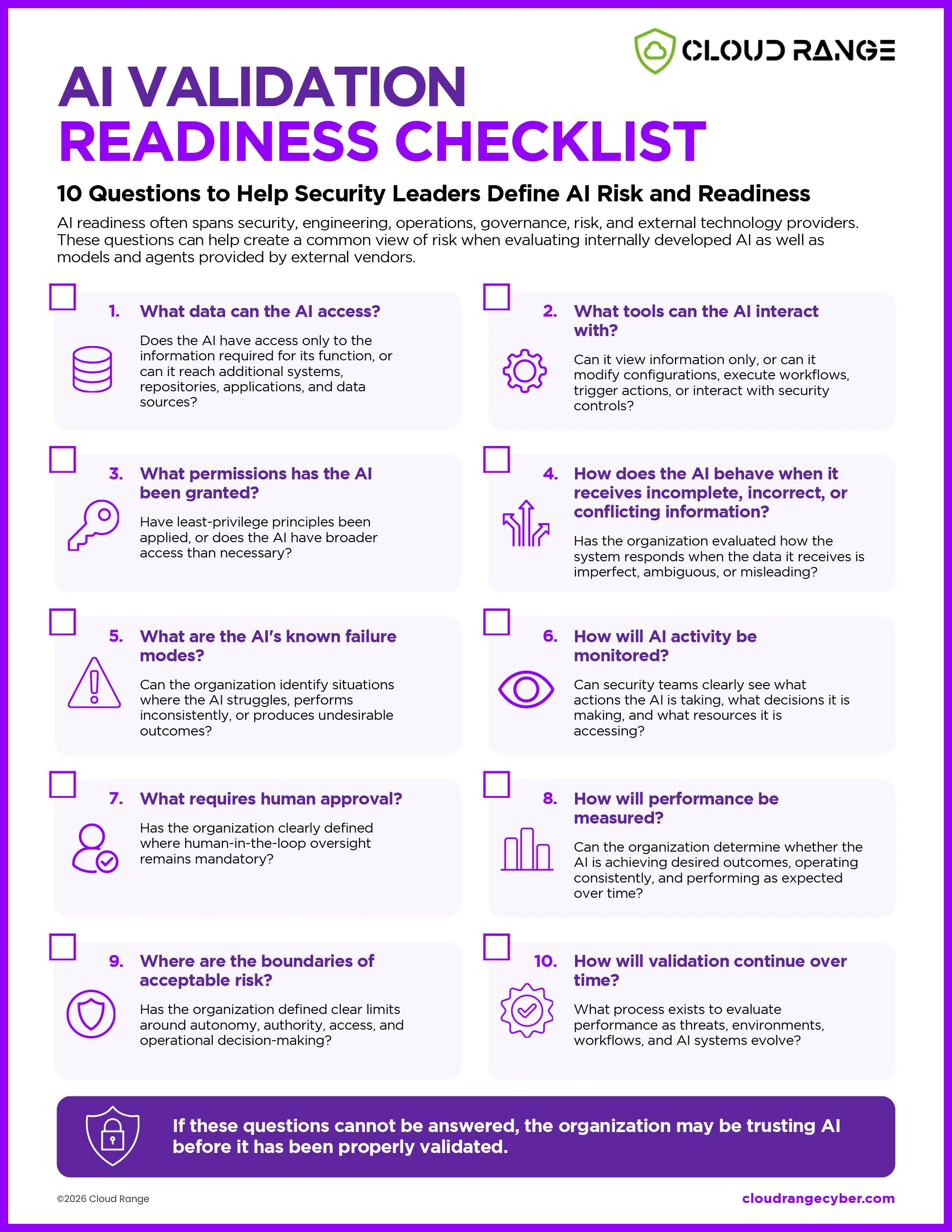
What data and tools can it access? What permissions has it been granted? What are its known failure modes? How does it respond to incomplete or conflicting information? When is human approval required? How will its activity and performance be monitored? Where are the boundaries of acceptable risk? And how will validation continue as the AI and its environment change?
Cloud Range's AI Validation Readiness Checklist brings these considerations together in 10 questions designed to help security leaders define AI risk and readiness. The checklist can also help create a common view across security, engineering, operations, governance, risk, and external technology providers.
For a broader approach, The Cyber Readiness Guide for Agentic AI provides a practical framework for training, testing, validating, and benchmarking AI throughout its lifecycle. It features the Cloud Range AI Readiness Framework™ and five steps to PROVE AI Readiness: Prepare & Train, Risk-Assess, Operationally Test, Validate & Benchmark, and Evaluate & Evolve.
[Get The Cyber Readiness Guide for Agentic AI]
Frequently Asked Questions
How do you determine if an AI agent is ready for production?
AI readiness should be based on evidence of how the agent performs under realistic operational conditions, including expected, unexpected, and adversarial situations. Organizations should also evaluate its access, authority, autonomy, potential impact, failure modes, and requirements for human oversight.
What is the difference between AI testing and AI validation?
Testing typically determines whether an AI system can perform specific tasks or behaviors. Validation goes further by evaluating operational performance across expected and unexpected conditions and building evidence about whether the AI can be trusted for its intended role.
When should an AI agent require human oversight?
Human oversight is particularly important when demonstrated performance, uncertainty, or the potential impact of an incorrect action makes independent operation too risky. Validation can help determine where greater autonomy is supported and where human judgment remains valuable.
How often should AI agents be validated?
AI agents should be revalidated as meaningful changes occur to models, tools, integrations, permissions, responsibilities, workflows, operating environments, threats, or known failure modes. Continuous validation helps organizations maintain current evidence of readiness rather than relying on results from an earlier point in time.